

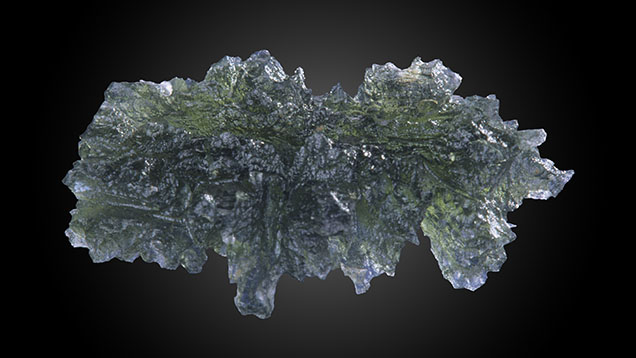
A well-formed moldavite tektite from the Czech Republic is the subject of this issue’s Quarterly Crystal. As tektite is technically not a crystal but rather a naturally occurring glass, flexibility was required to include this 18.48 ct leafy moldavite tektite in this issue’s column (figure 1). The recently examined specimen came from Norm Lehrman at the Tektite Source in Reno, Nevada.
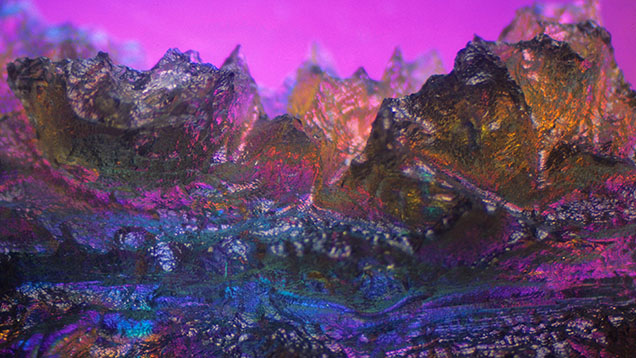
The transparent to translucent slightly grayish green moldavite measured 32.06 × 19.83 × 9.74 mm and hosted numerous unbroken spires on its heat-sculptured surface (figure 2). The fresh unbroken nature of the spires on this tektite is unusual considering the violent formational process of tektites. This makes well-formed unbroken moldavites rather rare.
This moldavite is from Besednice in the Český Krumlov District in the South Bohemian Region of the Czech Republic. Besednice moldavites are widely considered the finest examples of the material, and the beautiful olive green glass is often faceted into gemstones. However, moldavites with detailed leafy natural ornamentation such as this one are not cut, but instead kept as natural specimens. Moldavites are derived from the meteorite impact at the Nördlinger Ries crater in Germany approximately 15 million years ago. Moldavite tektites were first found in association with the Venus of Willendorf archaeological site in Austria, dating back approximately 29,000 years.
John Koivula is analytical microscopist, and Nathan Renfro is senior manager of colored stone identification, at GIA in Carlsbad, California.
A well-formed moldavite tektite from the Czech Republic is the subject of this issue’s Quarterly Crystal. As tektite is technically not a crystal but rather a naturally occurring glass, flexibility was required to include this 18.48 ct leafy moldavite tektite in this issue’s column (figure 1). The recently examined specimen came from Norm Lehrman at the Tektite Source in Reno, Nevada.
The transparent to translucent slightly grayish green moldavite measured 32.06 × 19.83 × 9.74 mm and hosted numerous unbroken spires on its heat-sculptured surface (figure 2). The fresh unbroken nature of the spires on this tektite is unusual considering the violent formational process of tektites. This makes well-formed unbroken moldavites rather rare.
This moldavite is from Besednice in the Český Krumlov District in the South Bohemian Region of the Czech Republic. Besednice moldavites are widely considered the finest examples of the material, and the beautiful olive green glass is often faceted into gemstones. However, moldavites with detailed leafy natural ornamentation such as this one are not cut, but instead kept as natural specimens. Moldavites are derived from the meteorite impact at the Nördlinger Ries crater in Germany approximately 15 million years ago. Moldavite tektites were first found in association with the Venus of Willendorf archaeological site in Austria, dating back approximately 29,000 years.
John Koivula is analytical microscopist, and Nathan Renfro is senior manager of colored stone identification, at GIA in Carlsbad, California.


