

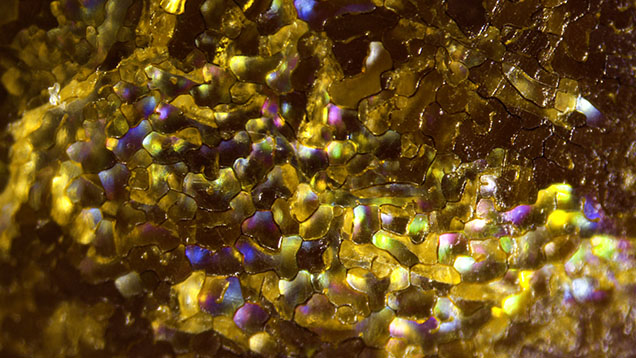
Pearls from Pinna species are commonly referred to as “pen pearls,” belonging to the Pinnidae family, and can be found in both nacreous and non-nacreous forms. Recently, the authors encountered a non-nacreous pen pearl with a unique surface phenomenon. This dark brown drop-shaped pearl, weighing 7.85 ct and measuring 11.75 × 9.97 mm, exhibited prominent surface-reaching cracks. Under high magnification with fiber-optic illumination, its surface displayed a pseudo-hexagonal mosaic pattern, with each cell revealing a vertical columnar arrangement of calcitic crystals (N. Sturman et al., “Observations on pearls reportedly from the Pinnidae family (pen pearls),” Fall 2014 G&G, pp. 202–215). The semitranslucent nature of these cells allowed light to diffract, producing a vibrant play-of-color featuring shades of pink, blue, yellow, and green (see above). Although natural opals also exhibit a similar surface phenomenon, it is rare to see this phenomenon in pearls.
Gauri Sarvankar is a senior staff gemologist at GIA in Mumbai. Abeer Al-Alawi is a consultant to GIA.
Pearls from Pinna species are commonly referred to as “pen pearls,” belonging to the Pinnidae family, and can be found in both nacreous and non-nacreous forms. Recently, the authors encountered a non-nacreous pen pearl with a unique surface phenomenon. This dark brown drop-shaped pearl, weighing 7.85 ct and measuring 11.75 × 9.97 mm, exhibited prominent surface-reaching cracks. Under high magnification with fiber-optic illumination, its surface displayed a pseudo-hexagonal mosaic pattern, with each cell revealing a vertical columnar arrangement of calcitic crystals (N. Sturman et al., “Observations on pearls reportedly from the Pinnidae family (pen pearls),” Fall 2014 G&G, pp. 202–215). The semitranslucent nature of these cells allowed light to diffract, producing a vibrant play-of-color featuring shades of pink, blue, yellow, and green (see above). Although natural opals also exhibit a similar surface phenomenon, it is rare to see this phenomenon in pearls.
Gauri Sarvankar is a senior staff gemologist at GIA in Mumbai. Abeer Al-Alawi is a consultant to GIA.


