

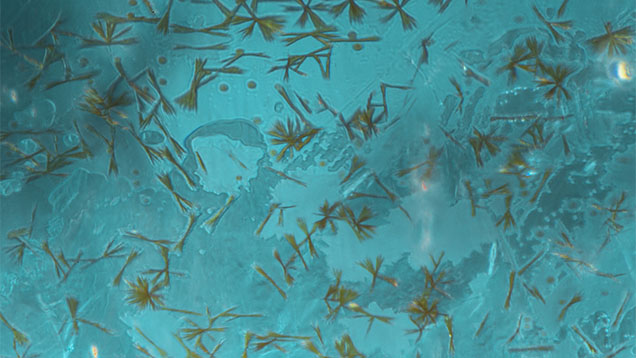
The authors recently examined a 0.89 ct green-blue apatite that contained intriguing brownish yellow mineral inclusions trapped within a large fracture (see above). Visual examination revealed these inclusions were sprays of goethite, a hydrous ferric oxide named in 1806 in honor of German scientist and author Johann Wolfgang von Goethe. These sprays formed epigenetically where the preexisting apatite host encountered groundwater enriched with ferric oxide. This groundwater invaded the fractures of the apatite and then precipitated crystalline goethite as it dried out (J.I. Koivula, “Useful visual clue indicating corundum heat treatment,” Fall 2013 G&G, pp. 160–161).
Michaela Damba is a senior staff gemologist, and John I. Koivula is analytical microscopist, at GIA in Carlsbad, California.
The authors recently examined a 0.89 ct green-blue apatite that contained intriguing brownish yellow mineral inclusions trapped within a large fracture (see above). Visual examination revealed these inclusions were sprays of goethite, a hydrous ferric oxide named in 1806 in honor of German scientist and author Johann Wolfgang von Goethe. These sprays formed epigenetically where the preexisting apatite host encountered groundwater enriched with ferric oxide. This groundwater invaded the fractures of the apatite and then precipitated crystalline goethite as it dried out (J.I. Koivula, “Useful visual clue indicating corundum heat treatment,” Fall 2013 G&G, pp. 160–161).
Michaela Damba is a senior staff gemologist, and John I. Koivula is analytical microscopist, at GIA in Carlsbad, California.


