

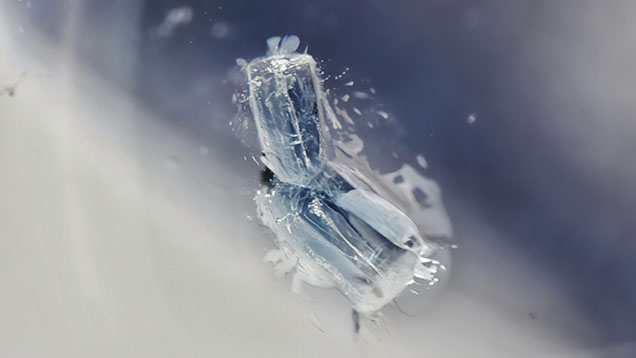
A 1.87 × 1.53 × 1.17 cm colorless quartz specimen containing interesting inclusions was recently studied by the authors. Microscopic examination revealed multiple well-formed blue hexagonal prismatic crystals embedded within the quartz (see above). These inclusions exhibited moderate pleochroism from greenish blue to light greenish blue, distinct from the non-pleochroic quartz host. Their morphology and optical properties suggested a beryl-group mineral. Spectroscopic analyses (infrared and Raman) confirmed the inclusions as beryl. Ultraviolet/visible absorption features attributed to Fe2+–Fe3+ intervalence transition indicated iron as the chromophore responsible for the blue coloration, further identifying the inclusions as aquamarine. This specimen illustrates the diagnostic value of crystal morphology, pleochroism, and spectroscopic analysis in inclusion identification.
Rui Rui Xing and Wingtak Lui are affiliated with Min De Minerals & Gem Research Co., Ltd. in Nanjing, China. Yu-Chen Huang is affiliated with Taiwan Central Gem Laboratory Co., Ltd.
A 1.87 × 1.53 × 1.17 cm colorless quartz specimen containing interesting inclusions was recently studied by the authors. Microscopic examination revealed multiple well-formed blue hexagonal prismatic crystals embedded within the quartz (see above). These inclusions exhibited moderate pleochroism from greenish blue to light greenish blue, distinct from the non-pleochroic quartz host. Their morphology and optical properties suggested a beryl-group mineral. Spectroscopic analyses (infrared and Raman) confirmed the inclusions as beryl. Ultraviolet/visible absorption features attributed to Fe2+–Fe3+ intervalence transition indicated iron as the chromophore responsible for the blue coloration, further identifying the inclusions as aquamarine. This specimen illustrates the diagnostic value of crystal morphology, pleochroism, and spectroscopic analysis in inclusion identification.
Rui Rui Xing and Wingtak Lui are affiliated with Min De Minerals & Gem Research Co., Ltd. in Nanjing, China. Yu-Chen Huang is affiliated with Taiwan Central Gem Laboratory Co., Ltd.


