

A fascinating quartz specimen with bright red inclusions was recently analyzed. It originated from the Chatian mine, Xiangxi, Hunan Province, China—a locality known for its fine cinnabar and mercury ore deposits.
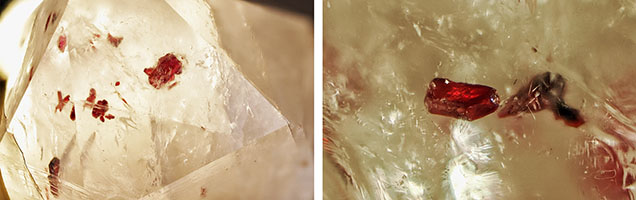
Visual inspection revealed striking red inclusions scattered throughout the quartz, appearing as high-luster, intensely red crystals, with some exhibiting well-defined habits (see above). Their vivid color and brilliant internal reflections were consistent with cinnabar. Microscopic examination showed that many inclusions were transparent to translucent with short prismatic or barrel-shaped habits embedded at various depths. To confirm their identity, Raman microspectrometry was performed. The spectrum showed characteristic cinnabar peaks, definitively identifying the inclusions as cinnabar.
Wingtak Lui and Rui Rui Xing are affiliated with Min De Minerals & Gem Research Co., Ltd. in Nanjing, China. Yu-Chen Huang is affiliated with Taiwan Central Gem Laboratory Co., Ltd.
A fascinating quartz specimen with bright red inclusions was recently analyzed. It originated from the Chatian mine, Xiangxi, Hunan Province, China—a locality known for its fine cinnabar and mercury ore deposits.
Visual inspection revealed striking red inclusions scattered throughout the quartz, appearing as high-luster, intensely red crystals, with some exhibiting well-defined habits (see above). Their vivid color and brilliant internal reflections were consistent with cinnabar. Microscopic examination showed that many inclusions were transparent to translucent with short prismatic or barrel-shaped habits embedded at various depths. To confirm their identity, Raman microspectrometry was performed. The spectrum showed characteristic cinnabar peaks, definitively identifying the inclusions as cinnabar.
Wingtak Lui and Rui Rui Xing are affiliated with Min De Minerals & Gem Research Co., Ltd. in Nanjing, China. Yu-Chen Huang is affiliated with Taiwan Central Gem Laboratory Co., Ltd.


