

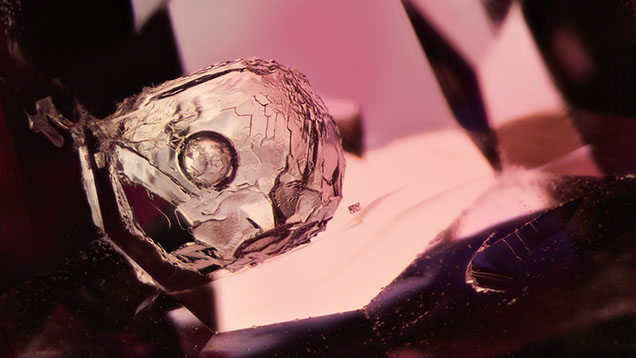
Gemology is a forensic science, and often what we don’t know can be as interesting as what we do know. Recently, the authors encountered a fascinating spinel. The owner noted that the stone (reportedly from Myanmar, formerly Burma) contained an inclusion feature with a bubble inside. Closer inspection revealed a negative crystal or cavity that indeed contained a mobile bubble (see above). With gentle heating from the warmth of the microscope’s light bulb, the authors were able to see the bubble expand and contract (see video below).
Loading video player...
Mystery Bubble in Spinel
Both micro-Raman and micro–Fourier-transform infrared spectroscopy were used in attempts to identify the liquid, but the results were inconclusive. The inclusion was inert when exposed to both long-wave (365 nm) and short-wave (254 nm) ultraviolet illumination.
Sulfur-rich fluids have been reported in Burmese spinel (Winter 2017 G&G Micro-World, p. 468).However, the sample did not match sulfur-rich fluids, either in appearance (sulfur-rich fluids tend to have a yellowish color) or in its Raman spectrum. In many cases, cavities in corundum displaying a similar appearance have been found to contain carbon dioxide. However, in the authors’ experience, it is often possible to identify carbon dioxide with Raman spectroscopy, whereas in this case, Raman spectroscopy did not yield a conclusive answer.
Currently, the exact nature of this inclusion remains a mystery.
E. Billie Hughes is a gemologist and cofounder of Lotus Gemology in Bangkok. Wim Vertriest is manager of field gemology at GIA in Bangkok.
Gemology is a forensic science, and often what we don’t know can be as interesting as what we do know. Recently, the authors encountered a fascinating spinel. The owner noted that the stone (reportedly from Myanmar, formerly Burma) contained an inclusion feature with a bubble inside. Closer inspection revealed a negative crystal or cavity that indeed contained a mobile bubble (see above). With gentle heating from the warmth of the microscope’s light bulb, the authors were able to see the bubble expand and contract (see video below).
Loading video player...
Mystery Bubble in Spinel
Both micro-Raman and micro–Fourier-transform infrared spectroscopy were used in attempts to identify the liquid, but the results were inconclusive. The inclusion was inert when exposed to both long-wave (365 nm) and short-wave (254 nm) ultraviolet illumination.
Sulfur-rich fluids have been reported in Burmese spinel (Winter 2017 G&G Micro-World, p. 468).However, the sample did not match sulfur-rich fluids, either in appearance (sulfur-rich fluids tend to have a yellowish color) or in its Raman spectrum. In many cases, cavities in corundum displaying a similar appearance have been found to contain carbon dioxide. However, in the authors’ experience, it is often possible to identify carbon dioxide with Raman spectroscopy, whereas in this case, Raman spectroscopy did not yield a conclusive answer.
Currently, the exact nature of this inclusion remains a mystery.
E. Billie Hughes is a gemologist and cofounder of Lotus Gemology in Bangkok. Wim Vertriest is manager of field gemology at GIA in Bangkok.


