

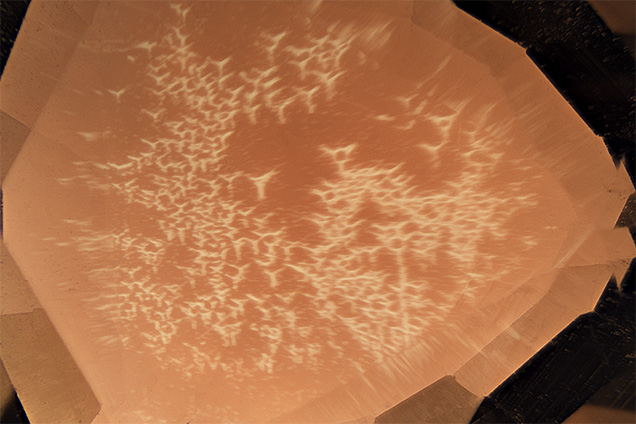
Tourmaline often displays color zoning. Popular examples include parti-color tourmaline (color zoning perpendicular to the c-axis) and watermelon tourmaline (pink and green color zoning parallel to the c-axis). A more peculiar type of abundant colorless zoning with windmill structures (see above) was seen by the author in an 8.55 ct pink faceted tourmaline. The table was cut perpendicular to the length of the crystal to reveal the windmill zoning as parallel to the c-axis, terminating at the crown and pavilion. This characteristic was visible with or without the use of a microscope. However, diffused transmitted light was necessary for observation in both cases. The stone did not possess any other visible inclusions, but some areas showed fully formed colorless hexagonal zoning following the c-axis. This feature bore a mild resemblance to windmill inclusions seen in sphalerite (Summer 2020 G&G; Micro-World, p. 295).
Tourmaline often displays color zoning. Popular examples include parti-color tourmaline (color zoning perpendicular to the c-axis) and watermelon tourmaline (pink and green color zoning parallel to the c-axis). A more peculiar type of abundant colorless zoning with windmill structures (see above) was seen by the author in an 8.55 ct pink faceted tourmaline. The table was cut perpendicular to the length of the crystal to reveal the windmill zoning as parallel to the c-axis, terminating at the crown and pavilion. This characteristic was visible with or without the use of a microscope. However, diffused transmitted light was necessary for observation in both cases. The stone did not possess any other visible inclusions, but some areas showed fully formed colorless hexagonal zoning following the c-axis. This feature bore a mild resemblance to windmill inclusions seen in sphalerite (Summer 2020 G&G; Micro-World, p. 295).


