

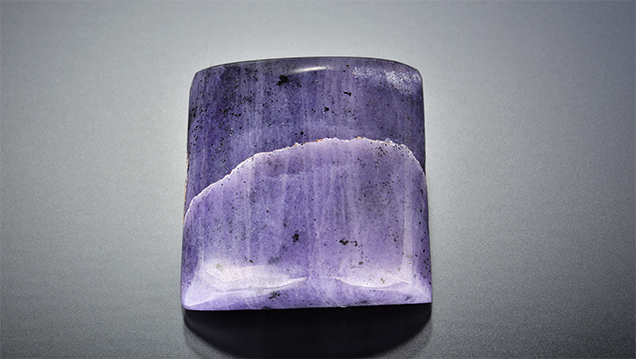
Recently, a 19.68 ct gray-purple stone (figure 1) was submitted to the Carlsbad laboratory for identification. The square cabochon was semitranslucent and had wispy white features throughout.
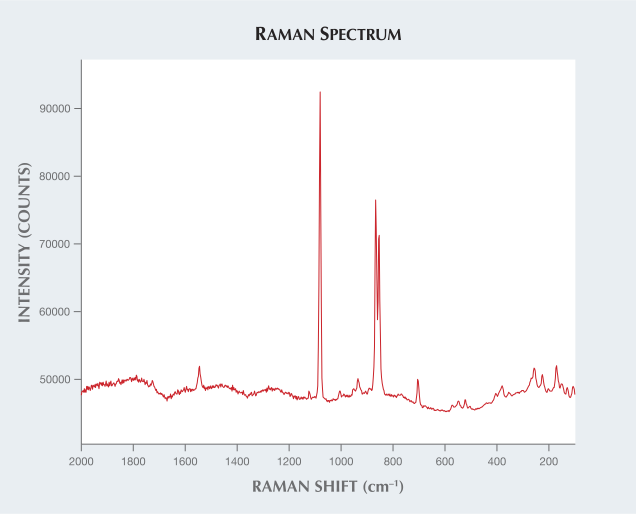
It had a refractive index of 1.68–1.64 and a hydrostatic specific gravity of 3.00. Raman spectroscopy identified it as spurrite (figure 2), which aligned with the gemological properties already measured. Spurrite is a nesosilicate with a chemical composition of Ca5(SiO4)2CO3 (J.W. Anthony et al., Handbook of Mineralogy, Vol. 2, Mineral Data Publishing, 1995). Analysis by energy-dispersive X-ray fluorescence (EDXRF) showed high amounts of calcium and silicon.
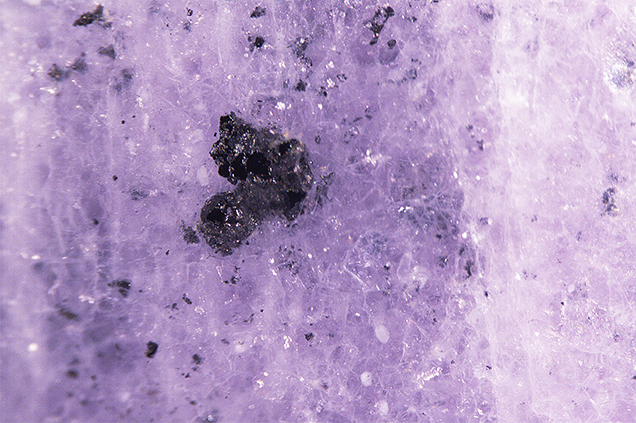
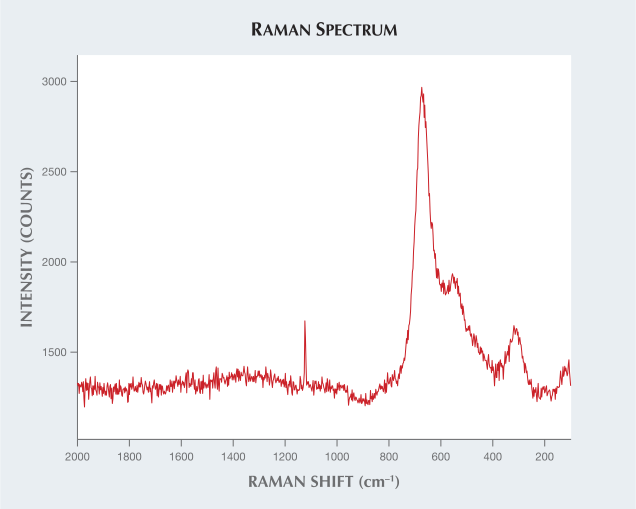
Spurrite occurs in high-temperature thermal metamorphism along the contact between carbonate rock and mafic magma (Anthony et al., 1995). A common inclusion found within spurrite is black metallic magnetite crystals. Raman spectroscopy identified the metallic opaque inclusions that broke the surface (figure 3) as magnetite (figure 4), further evidence that this stone was a spurrite.
Encountering stones that require more research and a little detective work, such as this spurrite, can enhance one’s curiosity about gemology.
Recently, a 19.68 ct gray-purple stone (figure 1) was submitted to the Carlsbad laboratory for identification. The square cabochon was semitranslucent and had wispy white features throughout.
It had a refractive index of 1.68–1.64 and a hydrostatic specific gravity of 3.00. Raman spectroscopy identified it as spurrite (figure 2), which aligned with the gemological properties already measured. Spurrite is a nesosilicate with a chemical composition of Ca5(SiO4)2CO3 (J.W. Anthony et al., Handbook of Mineralogy, Vol. 2, Mineral Data Publishing, 1995). Analysis by energy-dispersive X-ray fluorescence (EDXRF) showed high amounts of calcium and silicon.
Spurrite occurs in high-temperature thermal metamorphism along the contact between carbonate rock and mafic magma (Anthony et al., 1995). A common inclusion found within spurrite is black metallic magnetite crystals. Raman spectroscopy identified the metallic opaque inclusions that broke the surface (figure 3) as magnetite (figure 4), further evidence that this stone was a spurrite.
Encountering stones that require more research and a little detective work, such as this spurrite, can enhance one’s curiosity about gemology.


