

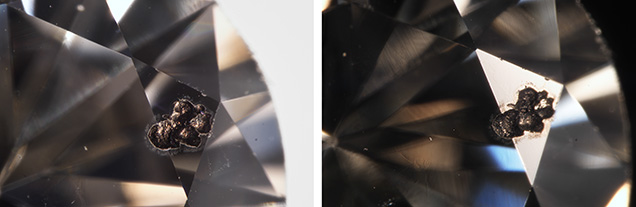
An atypical series of graphitized cavities was recently observed on a star facet (see above, left) of a 0.45 ct near-colorless round brilliant diamond. The presence of graphite was confirmed with Raman spectroscopy. The observed residue surrounding the craters could have been the result of a lasering process.
Laser sawing is now the standard way to shape rough into blocked shapes for brillianteering and polishing, and laser drilling is used to treat internal inclusions. The laser marks were not the typical oscillating lines of manufacturing remnants. These remnants on extra facets or natural surfaces are usually left behind for a variety of reasons such as saving weight. Neither was there an associated internal inclusion, which one would expect if this were a treatment, though a shallow inclusion could have been completely removed by this lasering. The only other internal inclusion was a dark brown crystal on the opposite side of the table, which had not been treated by lasering.
Reflected light (see above, right) revealed a small “island” of the original facet left behind, evidence that many craters in close proximity joined together to form one larger cavity. This is also the reason it is suspected that this cavity system was caused by a laser as opposed to another thermal process, such as a jeweler’s torch. Something like a torch is unlikely to have left an intact section of the facet in the center of a burnt-out cavity. The fact that there were many connected craters does make these cavities seem intentional, though the purpose is not obvious.


