

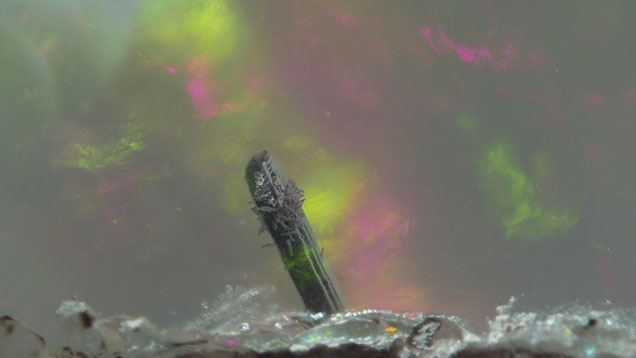
Due to the way they form, opals can encapsulate a wide range of inclusions. Among them, it is possible to distinguish two main categories. The first comprises inclusions that are present in the environment during the opal’s formation, such as the plant remnants extensively observed in material from Ethiopian deposits. The second consists of inclusions that crystallize simultaneously with the opal. They typically form rapidly, remain nano- to micro-sized, and are often responsible for changes in bodycolor. The colorless Mexican opal shown in the figure above frames a rather unique scene that belongs to the first category: a dark monolithic hornblende (dark amphibole) pseudomorph comprised of rutile (TiO2) and hematite (Fe2O3). The pseudomorph is partially covered by acicular red and gray secondary phases of the same composition, all enwrapped by bright, vivid green, blue, and pink colors resembling the aurora borealis.
Simon Gouzy is a postdoctoral research associate, Tyler Smith is manager of colored stone identification, and Elina Myagkaya is a research associate, at GIA in New York.


