

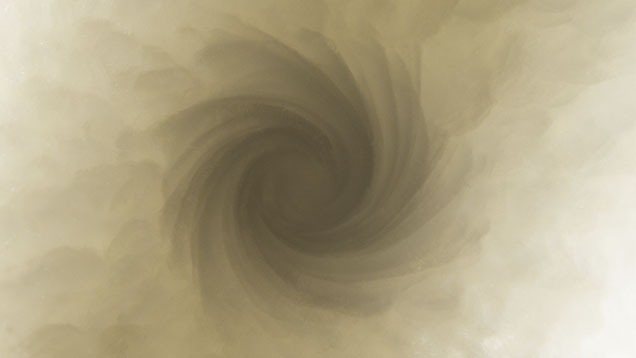
Spirals are among the most admired and unique features in Tridacninae pearls. Recently, the author observed a captivating spiral pattern in a Tridacninae pearl under microscopic observation.
The white button-shaped pearl, weighing 10.06 ct and measuring 11.88 × 9.80 mm, displayed spiral formations on both poles. The spiral shown in the figure above consisted of several blade-like structures radiating from the pole axis of the pearl, forming a pattern reminiscent of a storm. This type of spiral is believed to result from internal helices related to the pearl’s genetic origin (J.-P. Gauthier et al., “Evidence of rotation in flame-structure pearls from bivalves of the Tridacnidae family,” Summer 2019 G&G, pp. 216–228).
While previously documented spiral patterns have been reported using processed images, the spiral in this pearl was revealed solely through fiber-optic and strong transmitted lighting, making this pearl particularly intriguing.
Hazel “Wing Kiu” Fan is a staff gemologist at GIA in Hong Kong.


