

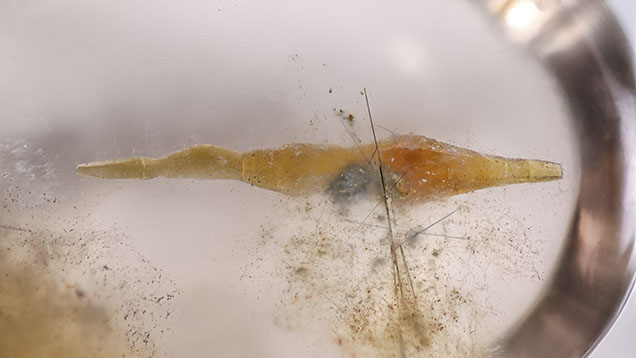
The authors recently examined a smoky quartz specimen from Machi, Mardan District, Khyber Pakhtunkhwa, Pakistan, exhibiting spindle-shaped crystal inclusions (figure 10). These orange crystals were analyzed and identified as parisite-(Ce) (Ca(Ce,La)2(CO3)3F2) by Raman and electron probe microanalysis. The surfaces of the parisite crystals were coated with a thin layer of monazite-(Ce) containing minor calcium rare earth element fluorocarbonates. The associated black needle crystals were also analyzed by scanning electron microscopy with energy-dispersive spectroscopy and identified as riebeckite (□Na2(Fe2+3Fe3+2) Si8O22(OH)2).
Although parisite inclusions have been found in quartz from Pakistan (Winter 2015 G&G Micro-World, pp. 443–444) and Colombia (E.J. Gübelin and J.I. Koivula, Photoatlas of Inclusions in Gemstones, Volume 2, Opinio Verlag, Basel, Switzerland, 2005, p. 621), this striking example is, to our knowledge, the first documented co-occurrence with riebeckite.
Hongtao Shen is affiliated with the State Key Laboratory of Geological Processes and Mineral Resources at the China University of Geosciences in Wuhan. Yinuo Wu, Qian Zhang, and Bahareh Shirdam are affiliated with the Gemological Institute, China University of Geosciences, Wuhan. Zhi Qu is affiliated with the Qingdao Institute of Measurement Technology in Shandong, Qingdao, China. Ho Yin Tsang is affiliated with Bedside Mineral Studio in Hong Kong SAR, China.


