

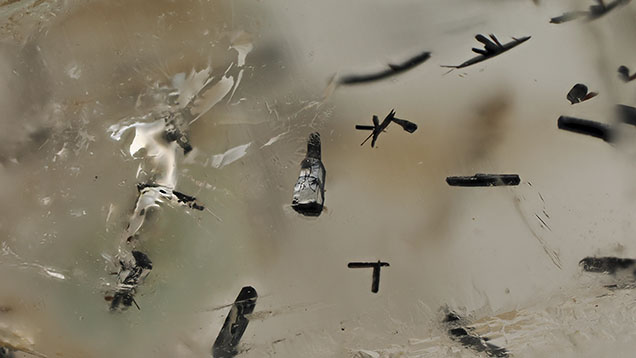
A recently examined transparent topaz, reportedly from Pakistan, hosted abundant dark mineral inclusions visible under low magnification. Microscopic examination revealed individual prismatic to lath-shaped crystals. In a few areas, several slender crystals occurred in close proximity with partial overlap, creating silhouettes reminiscent of birds in flight (see above). Some inclusions were accompanied by small feathers and localized stress features, consistent with the brittle nature and perfect cleavage of topaz.
Raman microspectrometry using 785 nm excitation on representative inclusions yielded spectra most consistent with wolframite-group minerals within the columbite supergroup. However, because Raman spectra among columbite-supergroup minerals can be similar and may not uniquely separate wolframite-group from columbite-group members, these inclusions are conservatively described as columbite-supergroup oxide minerals.
To further constrain composition, X-ray fluorescence screening was performed. Characteristic peaks attributable to manganese, iron, tungsten, and niobium were consistently observed. Expected tantalum peaks were also evaluated but remained below detection limits. This elemental signature is compatible with a columbite-supergroup oxide inclusion.
Wingtak Lui, Weilun Jing, and Rui Rui Xing are affiliated with Min De Minerals & Gem Research Co., Ltd. in Nanjing, China. Yu-Chen Huang is affiliated with Taiwan Central Gem Laboratory Co., Ltd.


