

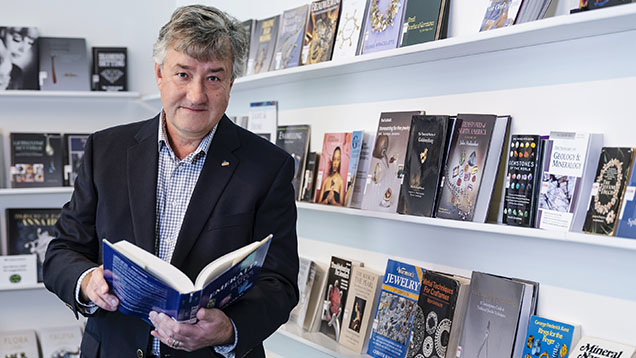
Welcome to the Fall 2026 issue of Gems & Gemology. This edition explores the science, history, and natural beauty of gem materials, from new research clarifying the identification of Paraíba tourmaline to a sweeping look at shell’s enduring role in human culture and a detailed investigation of the internal structures of freshwater cultured pearls.
“…the copper-to-iron concentration ratio provides a practical way to…designate a tourmaline as Paraíba.”
Some blue to green copper-bearing tourmaline can be enriched in iron, sometimes with so much iron that copper is no longer the main cause of color. In our first paper, Dr. Yusuke Katsurada and coauthors present a study of tourmaline from Brazil and Namibia using absorption spectroscopy and trace element chemistry to distinguish between copper-dominant and iron-dominant blue to green cuprian tourmaline. Results show that the copper-to-iron concentration ratio provides a practical way to determine whether the copper chromophore dominates enough to designate a tourmaline as Paraíba.
Shells represent nature’s symmetry, providing an inspiration for art and contemplation of divine perfection. In our second article, Britni LeCroy illuminates the beauty of shell, arguably the first valued and traded gem material. The paper traces shell’s long history, its use as currency and adornment, its global cultural value among indigenous people and European collectors alike, and its use in today’s gem trade.
The final article contributes to understanding the internal structure of freshwater cultured pearls from China’s Zhejiang Province. Xi Li and fellow researchers employ a variety of advanced techniques to analyze the cross sections and surfaces of freshwater bead cultured and non-bead cultured pearls. This study reveals a variety of distinct biomineralization morphologies including cavities that lead to so-called “tail pearls.”
Our regular sections have much to offer readers as well. The second installment of From the Field, our newest column, documents the GIA field gemology team’s visits to Pailin, Cambodia, over the last two decades. Lab Notes includes a pink CVD-grown diamond cleverly fashioned to resemble a natural rough, an array of non-bead cultured conch pearls, an unusual fluorescent opal from Japan, and a copper-bearing tourmaline showing evidence of color modification through heating. Micro-World’s remarkable miniature vistas resemble mystical beasts, illuminated cloudscapes, spiral storm-like patterns, and more. Highlights of our Gem News International section include an exceptional grossular garnet with prominent green halo inclusions, an interview with the American Museum of Natural History’s George Harlow, and a new turquoise grading system launched at the 2026 Turquoise United conference.
We hope you find plenty to enjoy in our Fall issue!
Duncan Pay is editor-in-chief of Gems & Gemology.


