

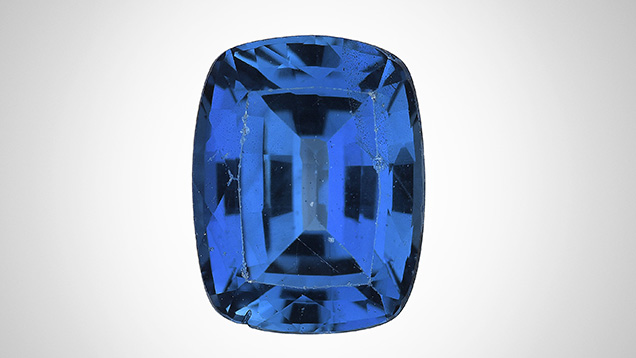
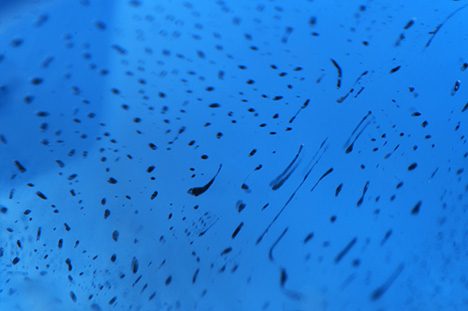
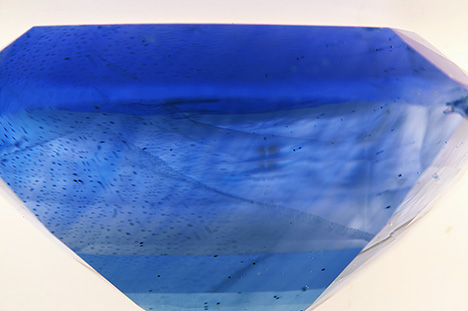
The Carlsbad laboratory recently received a blue cushion mixed cut measuring 9.07 × 7.07 × 4.62 mm (figure 1). Standard gemological testing gave a refractive index of 1.760–1.768, consistent with sapphire. Microscopic examination uncovered a fingerprint resembling those found in natural sapphires (figure 2). Closer examination revealed the fingerprint to be a flux fingerprint. When the stone was immersed in mineral oil, curved color banding diagnostic of flame-fusion lab-grown sapphire became visible (figure 3).
Typically, a flame-fusion-grown ruby or sapphire with healed fractures has undergone a process known as “quench crackling,” where fractures are created in the stone by heating and subsequent rapid cooling. This stone did not show the characteristic cellular fracturing created by this process, making the healed fractures appear even more natural. The randomly fractured stone had been immersed in a flux melt. The flux melt filled and partially healed the fractures while the stone gradually cooled, which resulted in natural-looking fingerprints of residual flux. This treatment is usually seen in flame-fusion synthetic rubies (K. Schmetzer and F.-J Schupp, “Flux-induced fingerprint patterns in synthetic ruby: An update,” Spring 1994 G&G, pp. 33–38).
The Carlsbad laboratory recently received a blue cushion mixed cut measuring 9.07 × 7.07 × 4.62 mm (figure 1). Standard gemological testing gave a refractive index of 1.760–1.768, consistent with sapphire. Microscopic examination uncovered a fingerprint resembling those found in natural sapphires (figure 2). Closer examination revealed the fingerprint to be a flux fingerprint. When the stone was immersed in mineral oil, curved color banding diagnostic of flame-fusion lab-grown sapphire became visible (figure 3).
Typically, a flame-fusion-grown ruby or sapphire with healed fractures has undergone a process known as “quench crackling,” where fractures are created in the stone by heating and subsequent rapid cooling. This stone did not show the characteristic cellular fracturing created by this process, making the healed fractures appear even more natural. The randomly fractured stone had been immersed in a flux melt. The flux melt filled and partially healed the fractures while the stone gradually cooled, which resulted in natural-looking fingerprints of residual flux. This treatment is usually seen in flame-fusion synthetic rubies (K. Schmetzer and F.-J Schupp, “Flux-induced fingerprint patterns in synthetic ruby: An update,” Spring 1994 G&G, pp. 33–38).


