

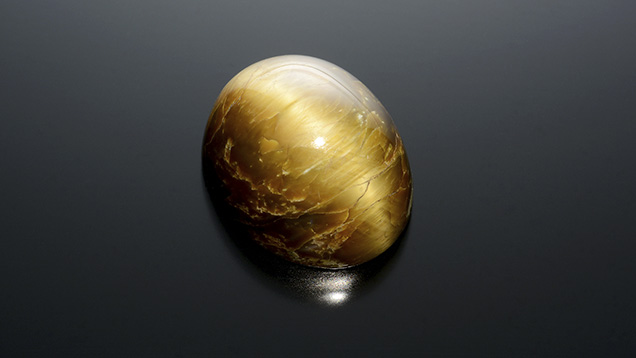
The Carlsbad laboratory received a 49.65 ct semitranslucent to opaque brownish yellow oval cabochon (figure 1) for identification. The stone’s most notable feature was its display of cat’s-eye phenomenon across the dome. It had a refractive index over the limit of the refractometer and a hydrostatic specific gravity of 3.74.
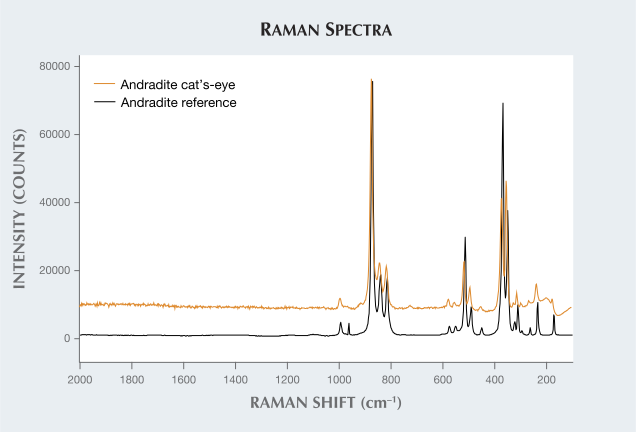
Raman spectroscopy was used to assist with the identification, and the data collected (figure 2) were matched with andradite garnet from the GIA reference database. Analysis by energy-dispersive X-ray fluorescence (EDXRF) showed a composition consistent with andradite garnet, Ca3Fe2(SiO4)3, further proof of the stone’s identity.
Internally, the stone is host to very fine and tightly packed needle-like inclusions running parallel to the base. With the stone cut as an oval cabochon, light is reflected off the inclusions, creating a rolling eye across the dome. This phenomenon is common in many gemstone species, and the demantoid variety of andradite garnet has been known to display cat’s-eye phenomenon (Spring 2018 Lab Notes, pp. 58–59). This stone is a larger example of cat’s-eye andradite garnet.
The Carlsbad laboratory received a 49.65 ct semitranslucent to opaque brownish yellow oval cabochon (figure 1) for identification. The stone’s most notable feature was its display of cat’s-eye phenomenon across the dome. It had a refractive index over the limit of the refractometer and a hydrostatic specific gravity of 3.74.
Raman spectroscopy was used to assist with the identification, and the data collected (figure 2) were matched with andradite garnet from the GIA reference database. Analysis by energy-dispersive X-ray fluorescence (EDXRF) showed a composition consistent with andradite garnet, Ca3Fe2(SiO4)3, further proof of the stone’s identity.
Internally, the stone is host to very fine and tightly packed needle-like inclusions running parallel to the base. With the stone cut as an oval cabochon, light is reflected off the inclusions, creating a rolling eye across the dome. This phenomenon is common in many gemstone species, and the demantoid variety of andradite garnet has been known to display cat’s-eye phenomenon (Spring 2018 Lab Notes, pp. 58–59). This stone is a larger example of cat’s-eye andradite garnet.


