

The impact of COVID-19 on the global gem trade is unquestionable. Traditional sales and services in most consuming countries came to a grinding halt. But the effects of lockdowns are also deeply felt in distant trade centers that rely on a steady supply of rough gemstones to feed their cutting, treating, and manufacturing industries.
Many of the brokers that take care of the transfer from producing countries to manufacturing hubs were suddenly unable to perform their vital role in the gemstone supply chain. Without a constant flow of new rough material, the wheels that drive the entire industry stop turning.
When a crisis like this happens, people are forced to turn to other sources. In the trading center of Chanthaburi, Thailand, the most obvious source of rough is easily overlooked: the back of the safe. Over the years, rough parcels of varying qualities have been kept for a rainy day, and in some cases material has been held back for years to keep prices buoyant via artificial scarcity.
Difficult times have seen many established businesses releasing some of these old parcels, sometimes of material not seen in volume for years (or even decades), such as Kenyan rubies from the John Saul mine or spessartine “Fanta” garnet from Nigeria.
Both authors had the privilege to handle one of the unique pieces that came from the back of someone’s safe into the market.
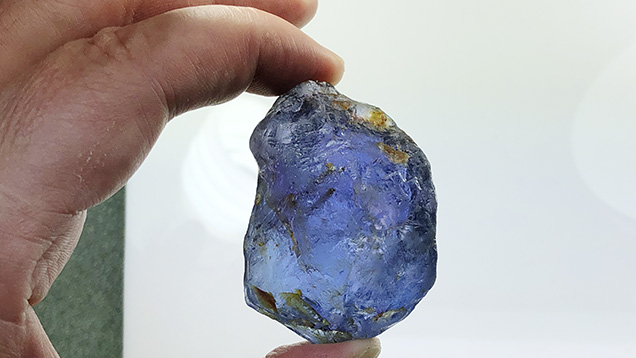
When SBL first saw this piece, his immediate reaction was that it was tanzanite. Several other colleagues and knowledgeable friends had the same first impression. It was difficult to imagine the true identity of this crystal, which was the size of a duck’s egg.

This was an 85 g, 427 ct piece of unheated cuprian or Paraíba-type tourmaline rough from Mozambique (figure 1). The stone was shown in the rough gem trading circuit of Chanthaburi near the end of May 2020. The GIA laboratory in Bangkok was able to do some limited testing on the stone, confirming that it was indeed a cuprian tourmaline (figure 2).
Large crystals of copper-bearing tourmaline were seen a decade ago at the advent of the Mavuco mines, but nothing of this size and quality has been seen on the open market for some time. For more on this material, see B.M. Laurs et al., “Copper-bearing (Paraíba-type) tourmaline from Mozambique,” Spring 2008 G&G;, pp. 4–30.
There is little doubt that such a large, prestigious piece attracts attention. After that, the consensus stops. While it is undeniable that this stone is very valuable, no one can agree on precisely how valuable it is.
The decisions of how to heat and cut it to open up that coveted blue-green color produced by copper are critical to the value-adding process. The results of heat treating Mozambican cuprian tourmaline can be seen in figure 22 of Laurs et al. (2008).
The unheated Paraíba gem was taken to the handful of factories in Chanthaburi and Bangkok capable of buying and value-adding such a piece. Factoring in cracks, internal stress, and the orientation of some inclusions, all the factories determined that the stone should be cut into several pieces.
But everyone had a different opinion of exactly how to manufacture this piece. And this is where the dreams of Paraíba profits get smashed on the anvil of market reality.
A well-saturated large crystal will, when cut into numerous smaller pieces, exhibit a paler saturation of the original hue. Given that the market will pay much more per carat for larger Paraíbas of intense color than for smaller paler Paraíbas, the range of potential value outcomes regarding the number of pieces to cut is dizzying.
Furthermore, heat treatment of any stone is unpredictable, but tourmaline is a notoriously fickle gem to heat. Would you simply remove the frosted surface and heat it before sawing and preforming? This carries the risk that the gem will shatter uncontrollably during heating, but also the possibility of producing a single Paraíba tourmaline of spectacular size and a coveted deeper color. Or would you play it safe by cutting and grinding it into several smaller preforms and heating the many pieces? This mitigates some of the risks, but sacrifices the potential for capitalizing on the size of the rough.
Even if you play it safe, there is still no guarantee that minor unintended cracking will not require the resizing and re-orientating of preforms before faceting, which could significantly reduce the final color and weight yet again.
The transformative yet risky process of slicing, preforming, heating, and faceting is in some ways a gamble. The reality is that neither buyer nor vendor actually knows what will happen, and there is an element of chance layered on top of the manufacturer’s skill. The coveted “Paraíba” hue and saturation after heating are not guaranteed, and cases of “overcooking” cuprian tourmalines until only a pale pink color remains are not unheard of. These many variables create unknowable outcomes.
The most prudent buyers calculate their offers based on the risk of as many as six or more paler pieces, and offer much lower than expected when seeing this magnificent piece of rough. The vendors optimistically hold to their dream of a higher value based upon two or three larger, well-saturated pieces—and with such a wide disparity in value-outcome consensus, rough gems like this take time to sell. In the case of this piece, no agreement was reached after several rounds of back-and-forth between the different parties, and the stone was returned to its owner.
While this story is not unique, it highlights many aspects of the gem trade that most people throughout the supply chain are unfamiliar with. In these tough COVID times, it becomes especially important to realize how many hands have handled the gems we are seeing and which challenges every single one faces.
Loading video player...
The impact of COVID-19 on the global gem trade is unquestionable. Traditional sales and services in most consuming countries came to a grinding halt. But the effects of lockdowns are also deeply felt in distant trade centers that rely on a steady supply of rough gemstones to feed their cutting, treating, and manufacturing industries.
Many of the brokers that take care of the transfer from producing countries to manufacturing hubs were suddenly unable to perform their vital role in the gemstone supply chain. Without a constant flow of new rough material, the wheels that drive the entire industry stop turning.
When a crisis like this happens, people are forced to turn to other sources. In the trading center of Chanthaburi, Thailand, the most obvious source of rough is easily overlooked: the back of the safe. Over the years, rough parcels of varying qualities have been kept for a rainy day, and in some cases material has been held back for years to keep prices buoyant via artificial scarcity.
Difficult times have seen many established businesses releasing some of these old parcels, sometimes of material not seen in volume for years (or even decades), such as Kenyan rubies from the John Saul mine or spessartine “Fanta” garnet from Nigeria.
Both authors had the privilege to handle one of the unique pieces that came from the back of someone’s safe into the market.
When SBL first saw this piece, his immediate reaction was that it was tanzanite. Several other colleagues and knowledgeable friends had the same first impression. It was difficult to imagine the true identity of this crystal, which was the size of a duck’s egg.
This was an 85 g, 427 ct piece of unheated cuprian or Paraíba-type tourmaline rough from Mozambique (figure 1). The stone was shown in the rough gem trading circuit of Chanthaburi near the end of May 2020. The GIA laboratory in Bangkok was able to do some limited testing on the stone, confirming that it was indeed a cuprian tourmaline (figure 2).
Large crystals of copper-bearing tourmaline were seen a decade ago at the advent of the Mavuco mines, but nothing of this size and quality has been seen on the open market for some time. For more on this material, see B.M. Laurs et al., “Copper-bearing (Paraíba-type) tourmaline from Mozambique,” Spring 2008 G&G;, pp. 4–30.
There is little doubt that such a large, prestigious piece attracts attention. After that, the consensus stops. While it is undeniable that this stone is very valuable, no one can agree on precisely how valuable it is.
The decisions of how to heat and cut it to open up that coveted blue-green color produced by copper are critical to the value-adding process. The results of heat treating Mozambican cuprian tourmaline can be seen in figure 22 of Laurs et al. (2008).
The unheated Paraíba gem was taken to the handful of factories in Chanthaburi and Bangkok capable of buying and value-adding such a piece. Factoring in cracks, internal stress, and the orientation of some inclusions, all the factories determined that the stone should be cut into several pieces.
But everyone had a different opinion of exactly how to manufacture this piece. And this is where the dreams of Paraíba profits get smashed on the anvil of market reality.
A well-saturated large crystal will, when cut into numerous smaller pieces, exhibit a paler saturation of the original hue. Given that the market will pay much more per carat for larger Paraíbas of intense color than for smaller paler Paraíbas, the range of potential value outcomes regarding the number of pieces to cut is dizzying.
Furthermore, heat treatment of any stone is unpredictable, but tourmaline is a notoriously fickle gem to heat. Would you simply remove the frosted surface and heat it before sawing and preforming? This carries the risk that the gem will shatter uncontrollably during heating, but also the possibility of producing a single Paraíba tourmaline of spectacular size and a coveted deeper color. Or would you play it safe by cutting and grinding it into several smaller preforms and heating the many pieces? This mitigates some of the risks, but sacrifices the potential for capitalizing on the size of the rough.
Even if you play it safe, there is still no guarantee that minor unintended cracking will not require the resizing and re-orientating of preforms before faceting, which could significantly reduce the final color and weight yet again.
The transformative yet risky process of slicing, preforming, heating, and faceting is in some ways a gamble. The reality is that neither buyer nor vendor actually knows what will happen, and there is an element of chance layered on top of the manufacturer’s skill. The coveted “Paraíba” hue and saturation after heating are not guaranteed, and cases of “overcooking” cuprian tourmalines until only a pale pink color remains are not unheard of. These many variables create unknowable outcomes.
The most prudent buyers calculate their offers based on the risk of as many as six or more paler pieces, and offer much lower than expected when seeing this magnificent piece of rough. The vendors optimistically hold to their dream of a higher value based upon two or three larger, well-saturated pieces—and with such a wide disparity in value-outcome consensus, rough gems like this take time to sell. In the case of this piece, no agreement was reached after several rounds of back-and-forth between the different parties, and the stone was returned to its owner.
While this story is not unique, it highlights many aspects of the gem trade that most people throughout the supply chain are unfamiliar with. In these tough COVID times, it becomes especially important to realize how many hands have handled the gems we are seeing and which challenges every single one faces.
Loading video player...


