

Gem-quality yellow synthetic diamonds have been a part of the industry for some time now. The gemological properties used to identify these synthetics have been extensively documented (see J.E. Shigley et al., “A chart for the separation of natural and synthetic diamonds,” Winter 1995 G&G, pp. 256–264).
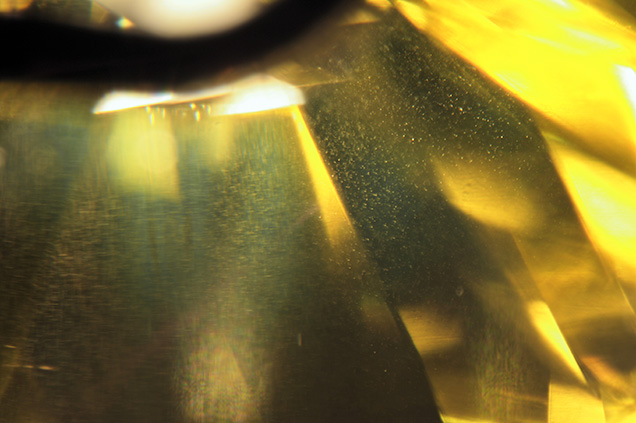
GIA’s New York laboratory recently tested a 0.99 ct synthetic diamond with Fancy Vivid yellow color, disclosed as a product of HPHT (high-pressure, high-temperature) growth, which showed some unusual gemological features. Its UV-Vis absorption spectra showed a smooth rise from 500 nm to higher energy. The mid-IR absorption spectra indicated a type I diamond with isolated nitrogen (C-center) responsible for the intense yellow color. The sample displayed a moderate greenish yellow fluorescence under long-wave UV and slightly stronger greenish yellow fluorescence under short-wave UV. It had a noticeable pinpoint flux cloud throughout (figure 1) and obvious yellow color zoning following the growth sectors—both characteristic gemological features of a yellow HPHT-grown synthetic diamond.
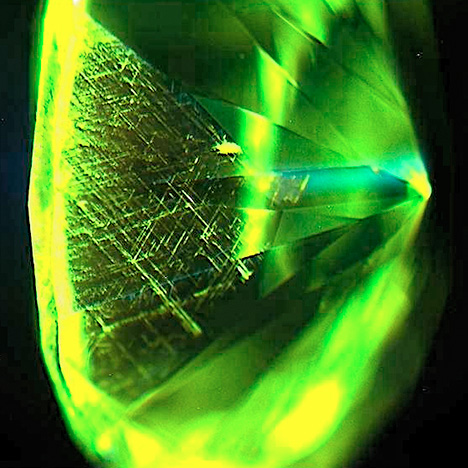
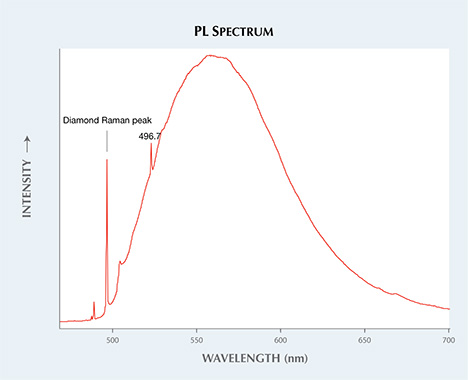
Unlike other yellow HPHT-grown synthetics, the DiamondView images showed an unusual green fluorescent crosshatched pattern within the hourglass structure (figure 2). This closely resembles the pattern seen in natural diamonds, which means the synthetic could have easily been mistaken for a natural diamond. Under cross-polarized light, it showed a mottled strain pattern with moderate birefringence colors (figure 3). Most yellow HPHT-grown synthetics do not show a clear strain pattern and have weak birefringence colors. Further examination with PL spectroscopy using blue (457 nm) laser excitation showed that the green fluorescence was caused by the S3 defect (496.7 nm, shown in figure 4), which is due to the presence of nickel—a very unusual feature for an HPHT-grown synthetic diamond.
This yellow HPHT-grown sample with gemological features we had not seen before shows once again how synthetic diamonds can be mistaken for natural diamonds. Caution must be taken, and careful gemological and spectroscopic analysis is essential.
Gem-quality yellow synthetic diamonds have been a part of the industry for some time now. The gemological properties used to identify these synthetics have been extensively documented (see J.E. Shigley et al., “A chart for the separation of natural and synthetic diamonds,” Winter 1995 G&G, pp. 256–264).
GIA’s New York laboratory recently tested a 0.99 ct synthetic diamond with Fancy Vivid yellow color, disclosed as a product of HPHT (high-pressure, high-temperature) growth, which showed some unusual gemological features. Its UV-Vis absorption spectra showed a smooth rise from 500 nm to higher energy. The mid-IR absorption spectra indicated a type I diamond with isolated nitrogen (C-center) responsible for the intense yellow color. The sample displayed a moderate greenish yellow fluorescence under long-wave UV and slightly stronger greenish yellow fluorescence under short-wave UV. It had a noticeable pinpoint flux cloud throughout (figure 1) and obvious yellow color zoning following the growth sectors—both characteristic gemological features of a yellow HPHT-grown synthetic diamond.
Unlike other yellow HPHT-grown synthetics, the DiamondView images showed an unusual green fluorescent crosshatched pattern within the hourglass structure (figure 2). This closely resembles the pattern seen in natural diamonds, which means the synthetic could have easily been mistaken for a natural diamond. Under cross-polarized light, it showed a mottled strain pattern with moderate birefringence colors (figure 3). Most yellow HPHT-grown synthetics do not show a clear strain pattern and have weak birefringence colors. Further examination with PL spectroscopy using blue (457 nm) laser excitation showed that the green fluorescence was caused by the S3 defect (496.7 nm, shown in figure 4), which is due to the presence of nickel—a very unusual feature for an HPHT-grown synthetic diamond.
This yellow HPHT-grown sample with gemological features we had not seen before shows once again how synthetic diamonds can be mistaken for natural diamonds. Caution must be taken, and careful gemological and spectroscopic analysis is essential.


