

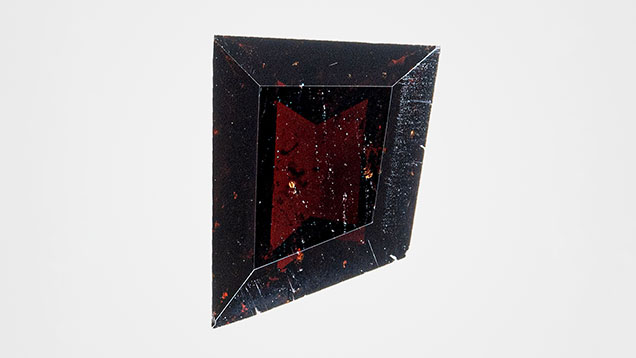
The Carlsbad laboratory recently received a transparent 1.58 ct dark red-brown freeform step cut measuring approximately 6.24 × 8.08 × 3.56 mm (see above). Standard gemological testing results included a specific gravity of 3.76 and a refractive index of 1.738–1.748. These properties suggested the stone was a rare transparent staurolite, which was confirmed by Raman spectroscopy. Typically, staurolite forms as opaque brown to black X- or cross-shaped twin crystals. Due to its typical cross-shaped appearance, the material was named using the Greek word for “cross,” stavros (J.W. Anthony et al., Eds., Handbook of Mineralogy, Mineralogical Society of America, Chantilly, VA, http://www.handbookofmineralogy.org/).
Transparent staurolite is extremely rare; this is only the second transparent specimen examined by GIA to date. However, examples of transparent staurolite as an inclusion have been documented in ruby (e.g., Spring 2020 G&G Micro-World, pp. 144–145; Fall 2020 G&G Micro-World, pp. 434–435).
Michaela Damba is a senior staff gemologist at GIA in Carlsbad, California.
The Carlsbad laboratory recently received a transparent 1.58 ct dark red-brown freeform step cut measuring approximately 6.24 × 8.08 × 3.56 mm (see above). Standard gemological testing results included a specific gravity of 3.76 and a refractive index of 1.738–1.748. These properties suggested the stone was a rare transparent staurolite, which was confirmed by Raman spectroscopy. Typically, staurolite forms as opaque brown to black X- or cross-shaped twin crystals. Due to its typical cross-shaped appearance, the material was named using the Greek word for “cross,” stavros (J.W. Anthony et al., Eds., Handbook of Mineralogy, Mineralogical Society of America, Chantilly, VA, http://www.handbookofmineralogy.org/).
Transparent staurolite is extremely rare; this is only the second transparent specimen examined by GIA to date. However, examples of transparent staurolite as an inclusion have been documented in ruby (e.g., Spring 2020 G&G Micro-World, pp. 144–145; Fall 2020 G&G Micro-World, pp. 434–435).
Michaela Damba is a senior staff gemologist at GIA in Carlsbad, California.


