

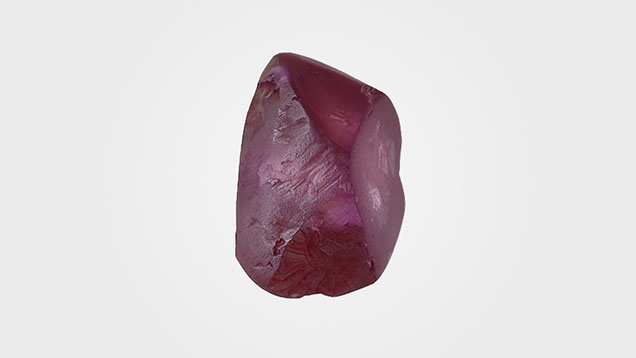
Recently, GIA’s Dubai laboratory received a purple diamond rough submitted for an identification report, weighing 3.93 ct and measuring 10.26 × 6.82 × 6.05 mm (figure 1). Fourier-transform infrared spectroscopy confirmed this diamond as type Ib with single substitutional nitrogen atoms (Ns0) of approximately 5 ppm, with characteristic peaks at 1130 and 1344 cm–1. The visible/near-infrared absorption spectrum showed features at 637 nm (NV–) and 741 nm (GR1). The combination of intense bodycolor, diamond type, and NV centers immediately raised suspicion for color treatment, which ultimately proved to be a combination of irradiation and subsequent annealing. Several noteworthy cases of laboratory-grown polished diamonds color treated to orange to pink hues have been reported by GIA (Summer 2015 Lab Notes, pp. 182–183; Winter 2023 Lab Notes, pp. 489–490), and such post-growth treatment is common in the trade. To the best of the author’s knowledge, however, naturally grown rough diamonds color treated to a vibrant purple color description are not commonly submitted for identification reports.
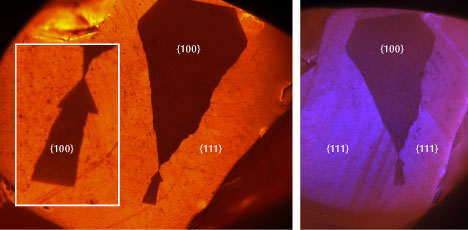
DiamondView images revealed interesting patterns that provided additional details on its growth history. Under deep-ultraviolet (UV) illumination (<230 nm), a dark non-fluorescing area resembling an arrow pointing toward a profile view of an elongated diamond was observed (figure 2). The rest of the diamond fluoresced a bright orange, which was likely associated with nitrogen vacancy (NV0/–) defects (K.S. Byrne et al., “Photochromic charge transfer processes in natural pink and brown diamonds,” Journal of Physics: Condensed Matter, Vol.26, No.3, 2014, article no. 035501). This distinct pattern indicated that several growth sectors were formed during the diamond’s natural growth processes.
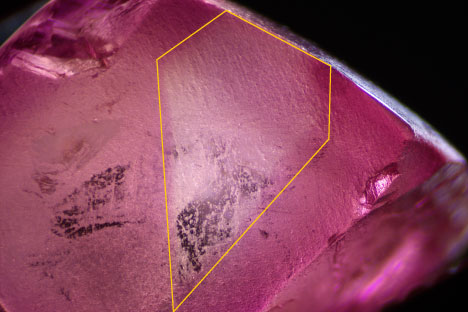
Impurities are usually heterogeneously distributed among different growth sectors due to their varying incorporation efficiencies and sector growth rates. Experiments have shown nitrogen concentration is typically higher in the {111} growth sector than in {100} (R.C. Burns et al., “Growth-sector dependence of optical features in large synthetic diamonds,” Journal of Crystal Growth, Vol. 104, No. 2, 1990, pp. 257–279). Upon irradiation followed by annealing, the pairing of Ns0 with vacancies to form NV centers becomes significantly more abundant in the {111} sector than in {100}. Photoluminescence spectroscopy further confirmed that {111} was predominated by the negatively charged NV defects (NV–), while {100} was dominated by the neutral form (NV0). The 575 nm (NV0) and 637 nm (NV–) peak areas in the {111} orange fluorescing areas, normalized to diamond Raman area, were also found to be 7 to nearly 140 times higher than in the {100} dark non-fluorescing region, respectively. The uneven coloration of the treated rough, as seen in visible light, also coincided with the observed differences in the distribution of NV centers between the {111} and {100} sectors (figure 3).
Purple color in diamond is often attributed to transmission windows in the blue and red regions of the visible spectrum. Interestingly, the introduction of NV centers in this stone produced an intense, unmodified purple bodycolor that lacked a pink component commonly observed in diamonds colored with NV centers. Recent studies have shown synthetic type Ib diamonds grown by high-pressure, high-temperature that have undergone high-dose electron irradiation followed by low-temperature annealing of ~750°C can develop an intense purple color within {111} sectors by having predominantly NV– centers over NV0. The concentration of NV– and the intensity of purple bodycolor in those experiments reached a maximum at ~850°C and gradually reduced at higher temperatures (N.M. Kazuchits et al., “Color evolution of type Ib synthetic diamonds after high dose electron irradiation followed by low-temperature annealing,” Diamond and Related Materials, Vol. 163, 2026, article no. 113334). Based on these observations, it is likely the examined rough underwent a carefully controlled treatment of irradiation followed by annealing at a low temperature.
While arrow facet patterns produced through polishing are often valued, this diamond, however, exhibits pareidolia in the form of an arrow “hidden” from within. It highlights the contrast between distinct growth sectors and is only discernible under deep-UV illumination.
Nick “Ka Chun” Chan is a senior staff gemologist at GIA in Dubai.
Recently, GIA’s Dubai laboratory received a purple diamond rough submitted for an identification report, weighing 3.93 ct and measuring 10.26 × 6.82 × 6.05 mm (figure 1). Fourier-transform infrared spectroscopy confirmed this diamond as type Ib with single substitutional nitrogen atoms (Ns0) of approximately 5 ppm, with characteristic peaks at 1130 and 1344 cm–1. The visible/near-infrared absorption spectrum showed features at 637 nm (NV–) and 741 nm (GR1). The combination of intense bodycolor, diamond type, and NV centers immediately raised suspicion for color treatment, which ultimately proved to be a combination of irradiation and subsequent annealing. Several noteworthy cases of laboratory-grown polished diamonds color treated to orange to pink hues have been reported by GIA (Summer 2015 Lab Notes, pp. 182–183; Winter 2023 Lab Notes, pp. 489–490), and such post-growth treatment is common in the trade. To the best of the author’s knowledge, however, naturally grown rough diamonds color treated to a vibrant purple color description are not commonly submitted for identification reports.
DiamondView images revealed interesting patterns that provided additional details on its growth history. Under deep-ultraviolet (UV) illumination (<230 nm), a dark non-fluorescing area resembling an arrow pointing toward a profile view of an elongated diamond was observed (figure 2). The rest of the diamond fluoresced a bright orange, which was likely associated with nitrogen vacancy (NV0/–) defects (K.S. Byrne et al., “Photochromic charge transfer processes in natural pink and brown diamonds,” Journal of Physics: Condensed Matter, Vol.26, No.3, 2014, article no. 035501). This distinct pattern indicated that several growth sectors were formed during the diamond’s natural growth processes.
Impurities are usually heterogeneously distributed among different growth sectors due to their varying incorporation efficiencies and sector growth rates. Experiments have shown nitrogen concentration is typically higher in the {111} growth sector than in {100} (R.C. Burns et al., “Growth-sector dependence of optical features in large synthetic diamonds,” Journal of Crystal Growth, Vol. 104, No. 2, 1990, pp. 257–279). Upon irradiation followed by annealing, the pairing of Ns0 with vacancies to form NV centers becomes significantly more abundant in the {111} sector than in {100}. Photoluminescence spectroscopy further confirmed that {111} was predominated by the negatively charged NV defects (NV–), while {100} was dominated by the neutral form (NV0). The 575 nm (NV0) and 637 nm (NV–) peak areas in the {111} orange fluorescing areas, normalized to diamond Raman area, were also found to be 7 to nearly 140 times higher than in the {100} dark non-fluorescing region, respectively. The uneven coloration of the treated rough, as seen in visible light, also coincided with the observed differences in the distribution of NV centers between the {111} and {100} sectors (figure 3).
Purple color in diamond is often attributed to transmission windows in the blue and red regions of the visible spectrum. Interestingly, the introduction of NV centers in this stone produced an intense, unmodified purple bodycolor that lacked a pink component commonly observed in diamonds colored with NV centers. Recent studies have shown synthetic type Ib diamonds grown by high-pressure, high-temperature that have undergone high-dose electron irradiation followed by low-temperature annealing of ~750°C can develop an intense purple color within {111} sectors by having predominantly NV– centers over NV0. The concentration of NV– and the intensity of purple bodycolor in those experiments reached a maximum at ~850°C and gradually reduced at higher temperatures (N.M. Kazuchits et al., “Color evolution of type Ib synthetic diamonds after high dose electron irradiation followed by low-temperature annealing,” Diamond and Related Materials, Vol. 163, 2026, article no. 113334). Based on these observations, it is likely the examined rough underwent a carefully controlled treatment of irradiation followed by annealing at a low temperature.
While arrow facet patterns produced through polishing are often valued, this diamond, however, exhibits pareidolia in the form of an arrow “hidden” from within. It highlights the contrast between distinct growth sectors and is only discernible under deep-UV illumination.
Nick “Ka Chun” Chan is a senior staff gemologist at GIA in Dubai.


