

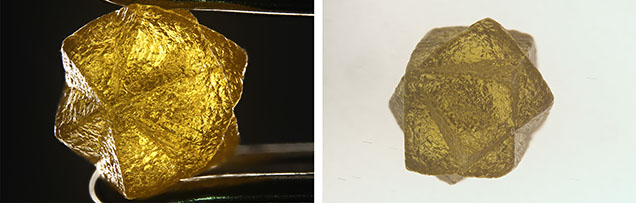
A 0.37 ct vivid orangy yellow rough diamond displaying penetration twinning, on loan from the GIA Museum, was recently examined by the author (see above). Growth twinning is a natural process involving the symmetrical intergrowth of two crystals of the same mineral. Diamonds can exhibit growth twinning as either contact twins or penetration twins. Contact growth twinning is commonly observed in octahedral diamonds, forming macles (e.g., A. Abduriyim and M. Kitamura, “External morphology and internal zonal structure of macle diamond,” Fall 2025 G&G, pp. 250–269). Much more rarely, interpenetrant twinning is observed in cuboid diamonds displaying fibrous growth (e.g., K. Sun et al., “Growth and crystallographic features of interpenetrant twins in natural diamonds,” American Mineralogist, Vol. 110, No. 8, 2025, pp. 1249–1256; J.W. Harris et al., “Morphology of monocrystalline diamond and its inclusions,” Reviews in Mineralogy and Geochemistry, Vol. 88, No. 1, 2022, pp. 119–166).
Spectroscopic analysis was performed to further characterize the diamond. Ultraviolet/visible spectroscopy revealed a broad absorption continuum primarily in the violet to blue regions of the visible spectrum. This is seen in diamonds colored by isolated substitutional nitrogen atoms (Ns0) or C-centers. Fourier-transform infrared spectroscopy detected these C-centers in addition to A-centers (paired nitrogen atoms), revealing this stone to be type IaA+Ib.
This natural diamond is an example of how “accidents” during crystal growth can result in fascinating mineral specimens.
Taryn Linzmeyer is an analytics research associate at GIA in Carlsbad, California.
A 0.37 ct vivid orangy yellow rough diamond displaying penetration twinning, on loan from the GIA Museum, was recently examined by the author (see above). Growth twinning is a natural process involving the symmetrical intergrowth of two crystals of the same mineral. Diamonds can exhibit growth twinning as either contact twins or penetration twins. Contact growth twinning is commonly observed in octahedral diamonds, forming macles (e.g., A. Abduriyim and M. Kitamura, “External morphology and internal zonal structure of macle diamond,” Fall 2025 G&G, pp. 250–269). Much more rarely, interpenetrant twinning is observed in cuboid diamonds displaying fibrous growth (e.g., K. Sun et al., “Growth and crystallographic features of interpenetrant twins in natural diamonds,” American Mineralogist, Vol. 110, No. 8, 2025, pp. 1249–1256; J.W. Harris et al., “Morphology of monocrystalline diamond and its inclusions,” Reviews in Mineralogy and Geochemistry, Vol. 88, No. 1, 2022, pp. 119–166).
Spectroscopic analysis was performed to further characterize the diamond. Ultraviolet/visible spectroscopy revealed a broad absorption continuum primarily in the violet to blue regions of the visible spectrum. This is seen in diamonds colored by isolated substitutional nitrogen atoms (Ns0) or C-centers. Fourier-transform infrared spectroscopy detected these C-centers in addition to A-centers (paired nitrogen atoms), revealing this stone to be type IaA+Ib.
This natural diamond is an example of how “accidents” during crystal growth can result in fascinating mineral specimens.
Taryn Linzmeyer is an analytics research associate at GIA in Carlsbad, California.


