

Gemologists use several key inclusions to aid in origin determination and to distinguish between naturally grown and laboratory-grown emeralds. Among these, two-phase and multiphase inclusions are particularly important. In addition, some characteristic inclusion features are particularly useful for origin determination, such as iridescent two-phase thin films reported in certain Russian emeralds.
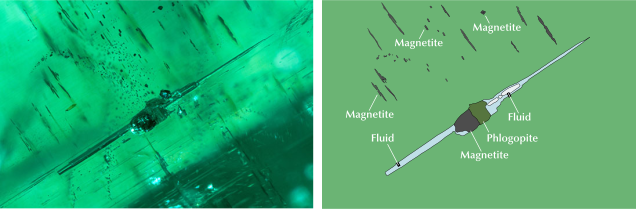
Recently, a 3.03 ct natural emerald was submitted to the Bangkok laboratory. Standard gemological testing, characteristic inclusion features, and chemistry supported a Zambian origin. Under the microscope, the stone showed the typical blocky two-phase inclusions expected in Zambian emerald, along with numerous opaque black metallic inclusions of various shapes and rare multiphase inclusions containing liquid, gas, and two solid phases (see above). Raman spectroscopy identified the opaque black metallic inclusions as magnetite and the transparent green solid in the multiphase inclusions as phlogopite.
Magnetite inclusions in Zambian emeralds are related to the host rock composition and the metamorphic-metasomatic formation process. Beryllium-rich fluids from pegmatites react with chromium-bearing talc-magnetite schist to form emeralds, which can trap magnetite grains from the surrounding rock (H. Zwaan et al., “Emeralds from the Kafubu area, Zambia,” Summer 2005 G&G, pp. 116–148). In this stone, magnetite occurred in unusually high abundance and exhibited four distinctive crystal habits. Dendritic or skeletal forms appeared as fine planar networks roughly parallel to the basal pinacoid. Blocky and octagonal crystals formed in more stable growth environments, while irregular crystals indicated more variable growth conditions. The simultaneous presence of all four forms is rarely observed in Zambian emeralds and makes this stone particularly unique.
The abundance of magnetite produced a weak but noticeable attraction to a handheld magnet, an uncommon physical response in emeralds. This observation, together with the inclusion assemblage and chemical data, supports a Zambian origin and highlights how unusual internal features can reflect natural geological variation.
This emerald expands the reference for Zambian material, showing that magnetite can appear not only as small, scattered grains but also in multiple distinct habits and in high quantities. The combination of abundant magnetite, four crystal forms, magnetic response, and rare multiphase inclusions makes this specimen particularly noteworthy and a fine example of natural variation in Zambian emeralds.
Aprisara Semapongpan is a staff gemologist at GIA in Bangkok.
Gemologists use several key inclusions to aid in origin determination and to distinguish between naturally grown and laboratory-grown emeralds. Among these, two-phase and multiphase inclusions are particularly important. In addition, some characteristic inclusion features are particularly useful for origin determination, such as iridescent two-phase thin films reported in certain Russian emeralds.
Recently, a 3.03 ct natural emerald was submitted to the Bangkok laboratory. Standard gemological testing, characteristic inclusion features, and chemistry supported a Zambian origin. Under the microscope, the stone showed the typical blocky two-phase inclusions expected in Zambian emerald, along with numerous opaque black metallic inclusions of various shapes and rare multiphase inclusions containing liquid, gas, and two solid phases (see above). Raman spectroscopy identified the opaque black metallic inclusions as magnetite and the transparent green solid in the multiphase inclusions as phlogopite.
Magnetite inclusions in Zambian emeralds are related to the host rock composition and the metamorphic-metasomatic formation process. Beryllium-rich fluids from pegmatites react with chromium-bearing talc-magnetite schist to form emeralds, which can trap magnetite grains from the surrounding rock (H. Zwaan et al., “Emeralds from the Kafubu area, Zambia,” Summer 2005 G&G, pp. 116–148). In this stone, magnetite occurred in unusually high abundance and exhibited four distinctive crystal habits. Dendritic or skeletal forms appeared as fine planar networks roughly parallel to the basal pinacoid. Blocky and octagonal crystals formed in more stable growth environments, while irregular crystals indicated more variable growth conditions. The simultaneous presence of all four forms is rarely observed in Zambian emeralds and makes this stone particularly unique.
The abundance of magnetite produced a weak but noticeable attraction to a handheld magnet, an uncommon physical response in emeralds. This observation, together with the inclusion assemblage and chemical data, supports a Zambian origin and highlights how unusual internal features can reflect natural geological variation.
This emerald expands the reference for Zambian material, showing that magnetite can appear not only as small, scattered grains but also in multiple distinct habits and in high quantities. The combination of abundant magnetite, four crystal forms, magnetic response, and rare multiphase inclusions makes this specimen particularly noteworthy and a fine example of natural variation in Zambian emeralds.
Aprisara Semapongpan is a staff gemologist at GIA in Bangkok.


