

Cartier and Myths, the first temporary exhibition at the Palazzo Nuovo of Rome’s Capitoline Museums, was on display for four months beginning in November 2025. The exhibition integrated Cartier jewels with one of the city’s most significant classical art collections—the permanent collection of marble sculptures assembled by Cardinal Alessandro Albani—and works on loan from other institutions and private collections. The result traced dialogues between the jewel and classical antiquity, and between the jewel and ancient mythological gods and zoomorphic symbols, from Cartier’s earliest neo-archaeological designs to contemporary interpretations. It also unveiled previously unseen photographs from a newly discovered album documenting Louis Cartier’s 1923 visits to archaeological sites Pompeii and Herculaneum. In the accompanying catalog composed of interdisciplinary essays, Cartier president and CEO Louis Ferla described the exhibition as “a return home, a reaffirmation of our indissoluble bond with a land that has profoundly shaped our creative vision,” recalling the transformative impact Italy once had on Louis Cartier.
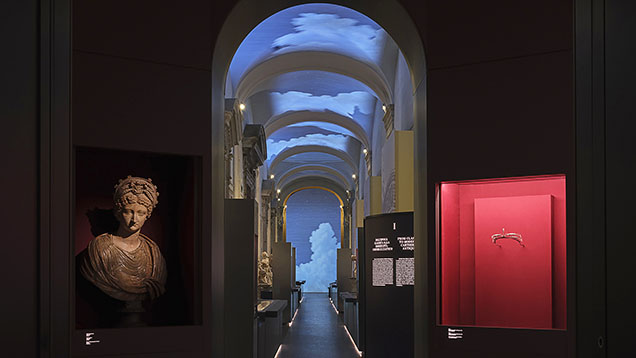
Exhibition visitors entered the Palazzo via a cinematic staircase designed by production designer and art director Dante Ferretti, featuring projections from his film work, including Pier Paolo Pasolini’s Medea and Terry Gilliam’s The Adventures of Baron Munchausen. Beyond the staircase, the atmosphere seemed suspended in time, with ambient music and animated projections of Giovanni Battista Piranesi’s clouds on the vaulted ceilings (figure 1). The jewelry cases alternated with ancient works in a perfect counterpoint. Each section concluded with video installations tracing the connections between Cartier and classical antiquity, while olfactory elements by Cartier perfumer Mathilde Laurent added another layer. The immersive multisensory experience invited engagement on multiple levels.
Cartier’s relationship with Rome stretches back to the Maison’s founding by Louis-François Cartier in 1847. Its inspirations have included French architecture, archaeology, classical antiquity, and myth. Jewelry historian Bianca Cappello, one of the exhibition curators, said the project began with Cartier’s desire “to create a dialogue with the works of Rome” in the world’s first public museums, established in the eighteenth century.
In shaping the exhibition, Cappello was asked to explore the jewels and narrate their scientific, historical, philological, and aesthetic aspects—an approach that immediately resonated with her. Archaeologist Stéphane Verger, director of the National Roman Museum, helped define the cultural framework and the narrative of myth through jewelry. Capitoline superintendent and archaeologist Claudio Parisi Presicce provided an in-depth study of the statues, highlighting their distinctive qualities and historical and cultural importance. The project relied on the expertise and resources of Cartier’s teams, including the archives in Paris, London, and New York, and the Cartier collection in Geneva, which expanded for the occasion and now comprises more than 3,500 pieces.
“The opportunity to see, handle, and study the jewels was extremely important,” Cappello said. “We discovered countless details that are impossible to perceive from an image.” These insights influenced the exhibition’s narrative and dialogue with Rome’s ancient art.
The exhibition could be understood on several levels. The first, Cappello said, was one of “formal beauty”: sculptures, vases, jewels, and other ancient works presented simply to be seen and appreciated. A second level explored the cultural terrain of classical antiquity and myth, themes that guided the selection of the pieces. Classicism, she noted, remains a persistent framework for how societies define and transmit ideas of beauty. Its principles have shaped aesthetics from ancient Greece through the Renaissance and Enlightenment and continue to inform Cartier’s design vocabulary.
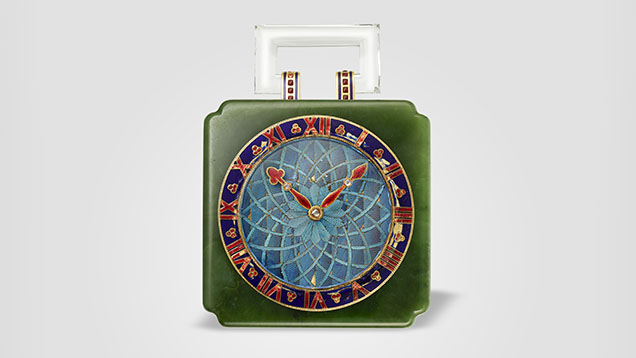
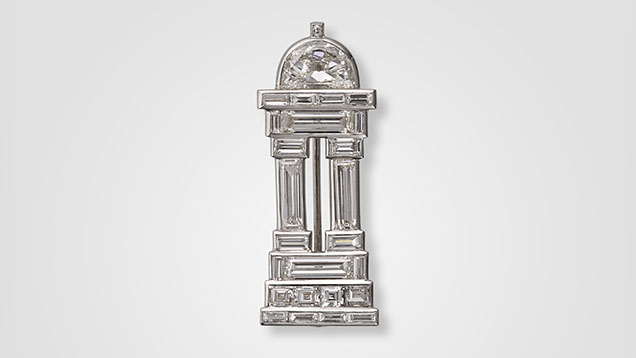
“Think of the golden ratio and Pythagorean geometry as the foundation of our perception of beauty and of the forms of nature,” Capello said. One example is a desk clock (figure 2) featuring a dial with the same pattern as the iconic pavement of the Piazza del Campidoglio—Michelangelo’s design rooted in the golden ratio and Pythagorean geometry. “We see these proportions in the Egyptian pyramids and in the Pantheon,” she continued. “In Cartier’s works, innovation is always balanced by these principles of classical proportion.” The “Temple” brooch (figure 3) further exemplifies this with its proportions, rectangular stones, stepped layers, and symmetry.
Myth was another important theme. “Myth survives through the centuries because it has always been able to effectively convey the invisible, feelings and emotions such as love and envy, embodied by deities and their stories,” Cappello said. She noted its influence in the late nineteenth century in early psychoanalytic research and the Symbolist movement in art, and its continued legacy today in symbols such as the panther, the serpent, and Medusa, all active in Cartier’s iconography.
The exhibition was divided into two halves. The first, a “historical-philological” section curated by Cappello, showed the evolution of Cartier’s approach to antiquity and myth: from the pastiche of the nineteenth century (combining and copying multiple historical periods) to the third generation—Louis, Jacques, and Pierre of the twentieth century—in which classical inspiration is no longer only decorative but communicates the complex symbolic meanings of myths. It also became playful and rich with historical references based on the new science of archaeology. The second half, curated by archaeologist Stéphane Verger, staged a narrative dialogue between classical myths and Cartier jewelry. These myths and symbols continue to be a powerful source of inspiration for contemporary design.
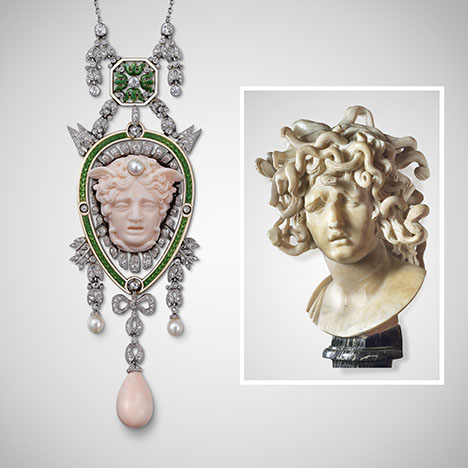
Among Cappello’s favorite pieces is the 1906 “Head of Medusa” pendant (figure 4, left), a high-relief cameo in angel skin coral. The cameo features diamonds, green guilloche enamel reminiscent of Fabergé, and a platinum setting. The head of Medusa is a copy of the one held by the Perseus statue sculpted by Antonio Canova at the Vatican Museums. Medusa fascinates and petrifies through her gaze (figure 4, right); she represents defense and protection but also the dangerous, rebellious, independent woman. According to a legend recounted by Ovid and Pliny the Elder, coral is born from Medusa’s blood falling into the sea and transforming into this precious material.
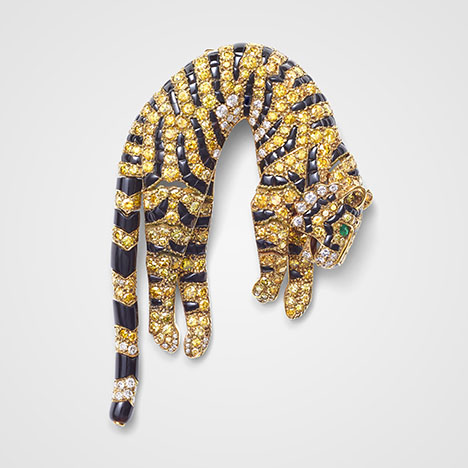
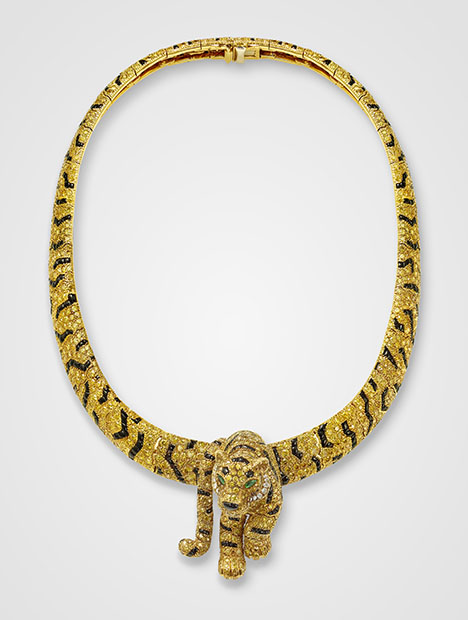
Another theme in the exhibition was the panther and other large cats—symbols associated with the elite since the mid-fifteenth century and linked to the myth of Jason and the Golden Fleece. Although the Golden Fleece comes from a ram, artists often reinterpreted Jason’s perilous voyage through the lens of contemporary imperial expansion, substituting large cat pelts for the fleece as symbols of elite status and the allure of distant lands. American heiress and philanthropist Barbara Hutton was among the first to commission Cartier jewelry featuring felines: a 1957 tiger brooch (figure 5) with diamonds ranging from colorless to varying hues, tones, and saturations of yellow. In the 1980s, Cartier developed its patented “fur setting” (figure 6): a type of pavé created by gemstones surrounded with tiny grains of gold, which are drawn into delicate threads over the stones to more realistically render a feline coat.
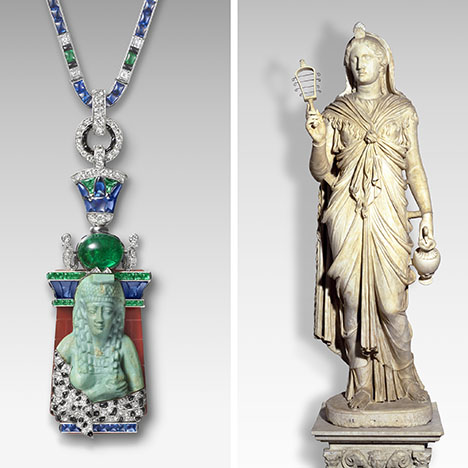
Another significant part of the exhibition was a necklace containing an Egyptian faience piece more than 3,500 years old, depicting a goddess representing the feminine mythos, with “panther skin” pavé—diamonds, onyx, and colored gemstones to resemble a panther’s spotted fur—added by Cartier to cover missing parts (figure 7). “It is rich in symbolism connected to the feminine myth: the Egyptian cult of Sekhmet [Isis], the goddess of healing but also chaos; the panther often depicted with Dionysus and the Maenads,” Cappello said.
Cartier revisited this myth in the 1920s, when women were asserting new forms of independence and influence—the era of designers Coco Chanel, Elsa Schiaparelli, and Jeanne Toussaint, who became the Maison’s creative director in 1933. Toussaint made the panther her signature motif, ensuring its place in Cartier’s visual language for decades to come.
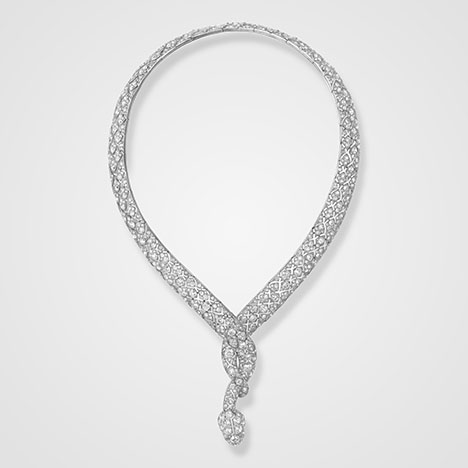
Cappello also pointed to the serpent as one of the exhibition’s central mythological figures. In antiquity, she explained, the serpent was regarded as a eudaemon, “a positive spirit” connecting humans and the divine. Herculaneum’s and Pompeii’s houses contained shrines featuring serpents, meant to lead souls toward good fortune. Jewelry shaped like coiled serpents was worn for good luck. A 1919 Cartier necklace (figure 8) reflects this heritage.
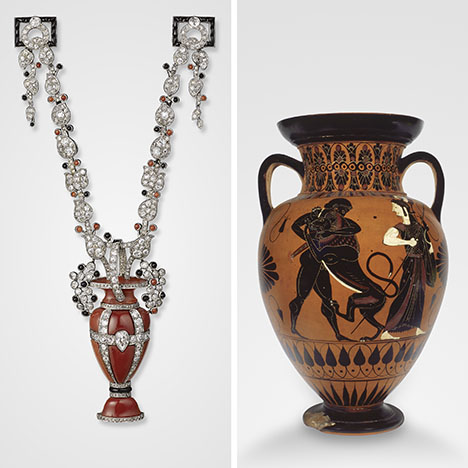
Capello highlighted many more jewels, each special for a particular reason. Some pieces carried strong anthropological significance, such as a brooch/pendant (figure 9) reflecting the significance of the amphora (vase) in Greek myth and culture. Together they took visitors on a journey beginning with ancient cultures—Egypt, Greece, Rome—through cycles of classical revival, influenced by the nineteenth- and twentieth-century cultures, and continuing today.
The intertwining of art, history, mythology, and symbolism in these pieces was undeniable, and all connected to something universally magical. Since time immemorial, humans have adorned themselves to communicate their uniqueness, status, and power; to express an ideal or a dream; to attract or to inspire awe. Through myths and archetypes, every jewel tells not only the story of the Maison Cartier but also a little of the human story. Cartier embodies these themes in this ongoing connection between the ancient and the innovative.
When asked what she hoped the public took away from the exhibition, Cappello said, “Beauty, because it represents positivity, [is] a feeling each of us radiates from within.” She described the exhibit as exploring a kind of beauty with ancient roots that can be understood through culture or felt through emotion. She pointed out that cultural exchange is nothing new: ancient Greece had contact with India as early as the fourth century BCE, and ancient Rome traded with China and Africa. For her, these historical connections reveal “a shared root of aesthetic languages,” creating fertile ground that revives beauty as a shared identity—one that, through its many interpretations, also allows for a rediscovery of individual expression. “Equality,” she noted, “is beauty with this same root.”
“This is the first time that haute jewelry has been put into direct dialogue with antiquity, from both a visual and intellectual perspective,” Cappello said. “This could be just the beginning of many other stories to tell, and an opportunity to see and experience jewelry in a completely different way.”
The exhibition was curated in cooperation with Roma Capitale – Department of Culture and the Capitoline Superintendency for Cultural Heritage, in collaboration with the Maison Cartier, with the support of Zètema Progetto Cultura. Sylvain Roca curated the exhibition’s installation project with the creative contribution of Dante Ferretti. The catalog Cartier and the Myth, published by Marsilio Arte, is available in Italian and English.
Fanny Raponi is a gemology instructor at GIA in London, as well as a jewelry designer and maker.
Cartier and Myths, the first temporary exhibition at the Palazzo Nuovo of Rome’s Capitoline Museums, was on display for four months beginning in November 2025. The exhibition integrated Cartier jewels with one of the city’s most significant classical art collections—the permanent collection of marble sculptures assembled by Cardinal Alessandro Albani—and works on loan from other institutions and private collections. The result traced dialogues between the jewel and classical antiquity, and between the jewel and ancient mythological gods and zoomorphic symbols, from Cartier’s earliest neo-archaeological designs to contemporary interpretations. It also unveiled previously unseen photographs from a newly discovered album documenting Louis Cartier’s 1923 visits to archaeological sites Pompeii and Herculaneum. In the accompanying catalog composed of interdisciplinary essays, Cartier president and CEO Louis Ferla described the exhibition as “a return home, a reaffirmation of our indissoluble bond with a land that has profoundly shaped our creative vision,” recalling the transformative impact Italy once had on Louis Cartier.
Exhibition visitors entered the Palazzo via a cinematic staircase designed by production designer and art director Dante Ferretti, featuring projections from his film work, including Pier Paolo Pasolini’s Medea and Terry Gilliam’s The Adventures of Baron Munchausen. Beyond the staircase, the atmosphere seemed suspended in time, with ambient music and animated projections of Giovanni Battista Piranesi’s clouds on the vaulted ceilings (figure 1). The jewelry cases alternated with ancient works in a perfect counterpoint. Each section concluded with video installations tracing the connections between Cartier and classical antiquity, while olfactory elements by Cartier perfumer Mathilde Laurent added another layer. The immersive multisensory experience invited engagement on multiple levels.
Cartier’s relationship with Rome stretches back to the Maison’s founding by Louis-François Cartier in 1847. Its inspirations have included French architecture, archaeology, classical antiquity, and myth. Jewelry historian Bianca Cappello, one of the exhibition curators, said the project began with Cartier’s desire “to create a dialogue with the works of Rome” in the world’s first public museums, established in the eighteenth century.
In shaping the exhibition, Cappello was asked to explore the jewels and narrate their scientific, historical, philological, and aesthetic aspects—an approach that immediately resonated with her. Archaeologist Stéphane Verger, director of the National Roman Museum, helped define the cultural framework and the narrative of myth through jewelry. Capitoline superintendent and archaeologist Claudio Parisi Presicce provided an in-depth study of the statues, highlighting their distinctive qualities and historical and cultural importance. The project relied on the expertise and resources of Cartier’s teams, including the archives in Paris, London, and New York, and the Cartier collection in Geneva, which expanded for the occasion and now comprises more than 3,500 pieces.
“The opportunity to see, handle, and study the jewels was extremely important,” Cappello said. “We discovered countless details that are impossible to perceive from an image.” These insights influenced the exhibition’s narrative and dialogue with Rome’s ancient art.
The exhibition could be understood on several levels. The first, Cappello said, was one of “formal beauty”: sculptures, vases, jewels, and other ancient works presented simply to be seen and appreciated. A second level explored the cultural terrain of classical antiquity and myth, themes that guided the selection of the pieces. Classicism, she noted, remains a persistent framework for how societies define and transmit ideas of beauty. Its principles have shaped aesthetics from ancient Greece through the Renaissance and Enlightenment and continue to inform Cartier’s design vocabulary.
“Think of the golden ratio and Pythagorean geometry as the foundation of our perception of beauty and of the forms of nature,” Capello said. One example is a desk clock (figure 2) featuring a dial with the same pattern as the iconic pavement of the Piazza del Campidoglio—Michelangelo’s design rooted in the golden ratio and Pythagorean geometry. “We see these proportions in the Egyptian pyramids and in the Pantheon,” she continued. “In Cartier’s works, innovation is always balanced by these principles of classical proportion.” The “Temple” brooch (figure 3) further exemplifies this with its proportions, rectangular stones, stepped layers, and symmetry.
Myth was another important theme. “Myth survives through the centuries because it has always been able to effectively convey the invisible, feelings and emotions such as love and envy, embodied by deities and their stories,” Cappello said. She noted its influence in the late nineteenth century in early psychoanalytic research and the Symbolist movement in art, and its continued legacy today in symbols such as the panther, the serpent, and Medusa, all active in Cartier’s iconography.
The exhibition was divided into two halves. The first, a “historical-philological” section curated by Cappello, showed the evolution of Cartier’s approach to antiquity and myth: from the pastiche of the nineteenth century (combining and copying multiple historical periods) to the third generation—Louis, Jacques, and Pierre of the twentieth century—in which classical inspiration is no longer only decorative but communicates the complex symbolic meanings of myths. It also became playful and rich with historical references based on the new science of archaeology. The second half, curated by archaeologist Stéphane Verger, staged a narrative dialogue between classical myths and Cartier jewelry. These myths and symbols continue to be a powerful source of inspiration for contemporary design.
Among Cappello’s favorite pieces is the 1906 “Head of Medusa” pendant (figure 4, left), a high-relief cameo in angel skin coral. The cameo features diamonds, green guilloche enamel reminiscent of Fabergé, and a platinum setting. The head of Medusa is a copy of the one held by the Perseus statue sculpted by Antonio Canova at the Vatican Museums. Medusa fascinates and petrifies through her gaze (figure 4, right); she represents defense and protection but also the dangerous, rebellious, independent woman. According to a legend recounted by Ovid and Pliny the Elder, coral is born from Medusa’s blood falling into the sea and transforming into this precious material.
Another theme in the exhibition was the panther and other large cats—symbols associated with the elite since the mid-fifteenth century and linked to the myth of Jason and the Golden Fleece. Although the Golden Fleece comes from a ram, artists often reinterpreted Jason’s perilous voyage through the lens of contemporary imperial expansion, substituting large cat pelts for the fleece as symbols of elite status and the allure of distant lands. American heiress and philanthropist Barbara Hutton was among the first to commission Cartier jewelry featuring felines: a 1957 tiger brooch (figure 5) with diamonds ranging from colorless to varying hues, tones, and saturations of yellow. In the 1980s, Cartier developed its patented “fur setting” (figure 6): a type of pavé created by gemstones surrounded with tiny grains of gold, which are drawn into delicate threads over the stones to more realistically render a feline coat.
Another significant part of the exhibition was a necklace containing an Egyptian faience piece more than 3,500 years old, depicting a goddess representing the feminine mythos, with “panther skin” pavé—diamonds, onyx, and colored gemstones to resemble a panther’s spotted fur—added by Cartier to cover missing parts (figure 7). “It is rich in symbolism connected to the feminine myth: the Egyptian cult of Sekhmet [Isis], the goddess of healing but also chaos; the panther often depicted with Dionysus and the Maenads,” Cappello said.
Cartier revisited this myth in the 1920s, when women were asserting new forms of independence and influence—the era of designers Coco Chanel, Elsa Schiaparelli, and Jeanne Toussaint, who became the Maison’s creative director in 1933. Toussaint made the panther her signature motif, ensuring its place in Cartier’s visual language for decades to come.
Cappello also pointed to the serpent as one of the exhibition’s central mythological figures. In antiquity, she explained, the serpent was regarded as a eudaemon, “a positive spirit” connecting humans and the divine. Herculaneum’s and Pompeii’s houses contained shrines featuring serpents, meant to lead souls toward good fortune. Jewelry shaped like coiled serpents was worn for good luck. A 1919 Cartier necklace (figure 8) reflects this heritage.
Capello highlighted many more jewels, each special for a particular reason. Some pieces carried strong anthropological significance, such as a brooch/pendant (figure 9) reflecting the significance of the amphora (vase) in Greek myth and culture. Together they took visitors on a journey beginning with ancient cultures—Egypt, Greece, Rome—through cycles of classical revival, influenced by the nineteenth- and twentieth-century cultures, and continuing today.
The intertwining of art, history, mythology, and symbolism in these pieces was undeniable, and all connected to something universally magical. Since time immemorial, humans have adorned themselves to communicate their uniqueness, status, and power; to express an ideal or a dream; to attract or to inspire awe. Through myths and archetypes, every jewel tells not only the story of the Maison Cartier but also a little of the human story. Cartier embodies these themes in this ongoing connection between the ancient and the innovative.
When asked what she hoped the public took away from the exhibition, Cappello said, “Beauty, because it represents positivity, [is] a feeling each of us radiates from within.” She described the exhibit as exploring a kind of beauty with ancient roots that can be understood through culture or felt through emotion. She pointed out that cultural exchange is nothing new: ancient Greece had contact with India as early as the fourth century BCE, and ancient Rome traded with China and Africa. For her, these historical connections reveal “a shared root of aesthetic languages,” creating fertile ground that revives beauty as a shared identity—one that, through its many interpretations, also allows for a rediscovery of individual expression. “Equality,” she noted, “is beauty with this same root.”
“This is the first time that haute jewelry has been put into direct dialogue with antiquity, from both a visual and intellectual perspective,” Cappello said. “This could be just the beginning of many other stories to tell, and an opportunity to see and experience jewelry in a completely different way.”
The exhibition was curated in cooperation with Roma Capitale – Department of Culture and the Capitoline Superintendency for Cultural Heritage, in collaboration with the Maison Cartier, with the support of Zètema Progetto Cultura. Sylvain Roca curated the exhibition’s installation project with the creative contribution of Dante Ferretti. The catalog Cartier and the Myth, published by Marsilio Arte, is available in Italian and English.
Fanny Raponi is a gemology instructor at GIA in London, as well as a jewelry designer and maker.


