

The authors visited many pearl vendors at the AGTA, Gem & Jewelry Exchange (GJX), and Pueblo Gem & Mineral shows to gain insight into the past year’s global pearl market. Since the surge of global pearl demand and cultured pearl prices in 2023, the market has experienced some correction over the last two years, providing American buyers with more opportunities to source the goods they need. Most vendors reported a stronger show compared to last year, although trends varied slightly across sectors.
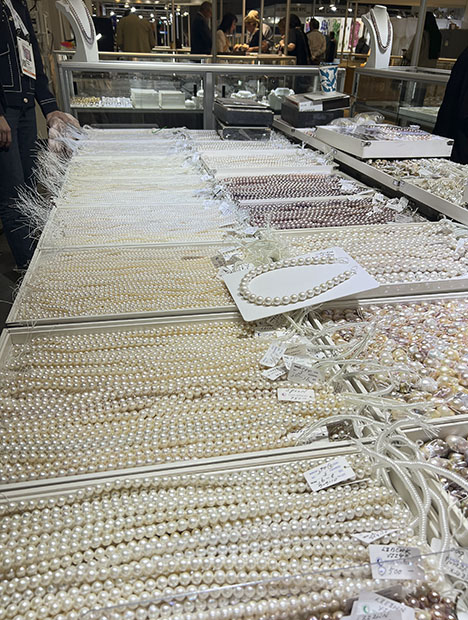
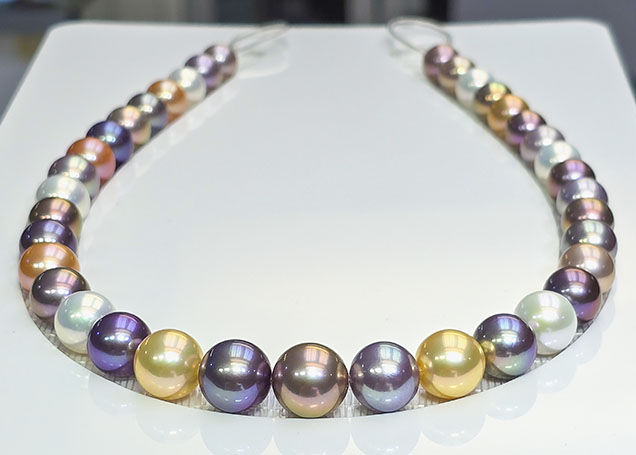
At all three shows, large round and near-round freshwater bead cultured pearls, often referred to as “Edison” pearls (C. Zhou et al., “Detection of color treatment and optical brightening in Chinese freshwater “Edison” pearls,” Summer 2021 G&G, pp. 124–134), dominated the market due to the continuous improvement of color, size range, and quality levels over the past five years (figure 1). Edison pearls typically range in size from 9 mm to more than 15 mm. Despite a noticeable price increase, buyers continue to find great potential in these pearls, as they remain much more affordable than their saltwater counterparts. While multicolor strands were available, uniformly colored strands were most common. Single loose Edison pearls and pairs were also readily accessible. These pearls were carried by not only pearl vendors but also those selling beads and other colored gemstones. In addition, small near-round and round freshwater bead cultured pearls from China were available from various vendors, predominantly in white but also in other colors (figure 2). Some of these pearls now reach 6 to 7 mm, a size noticeably larger than in previous years and comparable to typical akoya pearls. Based on the authors’ observations, the quality of these freshwater bead cultured pearls has continued to improve.
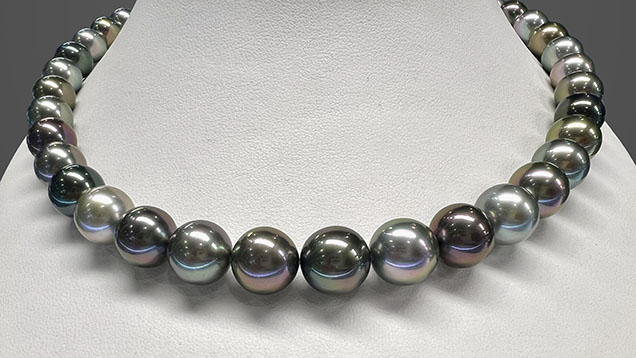
For saltwater cultured pearls, despite relatively low production, Tahitian pearls remained in demand at this year’s shows, with color being a significant draw for buyers, particularly the highly desired “peacock” variety for its combination of green bodycolor and significant overtone or orient. Various shades and tones of gray continued to be a classic choice for many. Though uniformly colored strands and pairs were still the mainstream inventory at the shows, multicolored Tahitian strands began to attract more attention (figure 3). Demand for Tahitian pearls in the 6 to 7 mm range remained consistent, but supply was very limited, with only a few dealers carrying these smaller sizes.
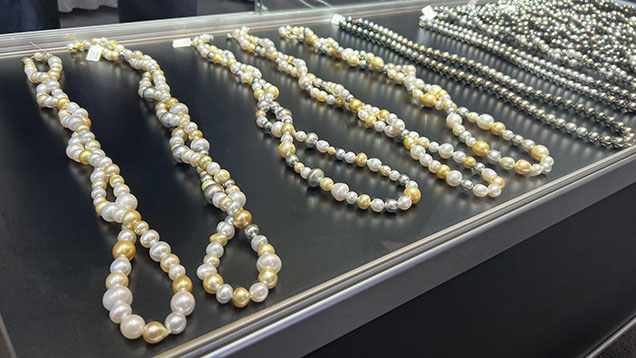
The demand for South Sea pearls, both white and golden, held steady. South Sea strands combining variously shaped white and golden pearls, sometimes paired with Tahitians, were a notable trend this year, displayed by many vendors (figure 4). Akoya pearls were also readily available, especially those of higher quality produced in Japan. Smaller untreated akoya pearls in 2 to 5 mm sizes from Vietnam were offered as well, often in white, cream, yellow, and silver.
In addition to these four major types of cultured pearls, vendors carried a very limited supply of cultured Pteria sterna pearls from Mexico. Non-bead cultured (NBC) freshwater pearls have become more difficult to source recently, as many Chinese farms have shifted their focus to producing bead cultured pearls. NBC saltwater pearls, often referred to as cultured “keshi” in the trade, were limited in supply, prompting buyers to take a more proactive approach to sourcing.
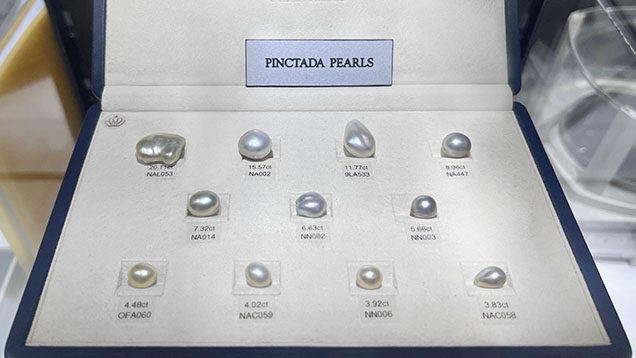
Natural pearls, both nacreous and non-nacreous, were exhibited by only a small group of vendors, with abalone and American freshwater pearls dominating the nacreous selection. Pinctada and Pteria natural pearls were spotted around the shows (figure 5), though only in limited quantities. While a variety of non-nacreous pearls were represented, conch, melo, and tridacninae subfamily (clam) pearls comprised the majority of this sector.
Overall, the pearl market has become more multifaceted than ever before with the availability of so many varieties offered at a more reasonable price point than in previous years.
Tao Hsu is technical editor for Gems & Gemology, and Artitaya Homkrajae is manager of pearl identification, at GIA in Carlsbad, California. Akira Hyatt is a pearl gemology specialist at GIA in New York.
The authors visited many pearl vendors at the AGTA, Gem & Jewelry Exchange (GJX), and Pueblo Gem & Mineral shows to gain insight into the past year’s global pearl market. Since the surge of global pearl demand and cultured pearl prices in 2023, the market has experienced some correction over the last two years, providing American buyers with more opportunities to source the goods they need. Most vendors reported a stronger show compared to last year, although trends varied slightly across sectors.
At all three shows, large round and near-round freshwater bead cultured pearls, often referred to as “Edison” pearls (C. Zhou et al., “Detection of color treatment and optical brightening in Chinese freshwater “Edison” pearls,” Summer 2021 G&G, pp. 124–134), dominated the market due to the continuous improvement of color, size range, and quality levels over the past five years (figure 1). Edison pearls typically range in size from 9 mm to more than 15 mm. Despite a noticeable price increase, buyers continue to find great potential in these pearls, as they remain much more affordable than their saltwater counterparts. While multicolor strands were available, uniformly colored strands were most common. Single loose Edison pearls and pairs were also readily accessible. These pearls were carried by not only pearl vendors but also those selling beads and other colored gemstones. In addition, small near-round and round freshwater bead cultured pearls from China were available from various vendors, predominantly in white but also in other colors (figure 2). Some of these pearls now reach 6 to 7 mm, a size noticeably larger than in previous years and comparable to typical akoya pearls. Based on the authors’ observations, the quality of these freshwater bead cultured pearls has continued to improve.
For saltwater cultured pearls, despite relatively low production, Tahitian pearls remained in demand at this year’s shows, with color being a significant draw for buyers, particularly the highly desired “peacock” variety for its combination of green bodycolor and significant overtone or orient. Various shades and tones of gray continued to be a classic choice for many. Though uniformly colored strands and pairs were still the mainstream inventory at the shows, multicolored Tahitian strands began to attract more attention (figure 3). Demand for Tahitian pearls in the 6 to 7 mm range remained consistent, but supply was very limited, with only a few dealers carrying these smaller sizes.
The demand for South Sea pearls, both white and golden, held steady. South Sea strands combining variously shaped white and golden pearls, sometimes paired with Tahitians, were a notable trend this year, displayed by many vendors (figure 4). Akoya pearls were also readily available, especially those of higher quality produced in Japan. Smaller untreated akoya pearls in 2 to 5 mm sizes from Vietnam were offered as well, often in white, cream, yellow, and silver.
In addition to these four major types of cultured pearls, vendors carried a very limited supply of cultured Pteria sterna pearls from Mexico. Non-bead cultured (NBC) freshwater pearls have become more difficult to source recently, as many Chinese farms have shifted their focus to producing bead cultured pearls. NBC saltwater pearls, often referred to as cultured “keshi” in the trade, were limited in supply, prompting buyers to take a more proactive approach to sourcing.
Natural pearls, both nacreous and non-nacreous, were exhibited by only a small group of vendors, with abalone and American freshwater pearls dominating the nacreous selection. Pinctada and Pteria natural pearls were spotted around the shows (figure 5), though only in limited quantities. While a variety of non-nacreous pearls were represented, conch, melo, and tridacninae subfamily (clam) pearls comprised the majority of this sector.
Overall, the pearl market has become more multifaceted than ever before with the availability of so many varieties offered at a more reasonable price point than in previous years.
Tao Hsu is technical editor for Gems & Gemology, and Artitaya Homkrajae is manager of pearl identification, at GIA in Carlsbad, California. Akira Hyatt is a pearl gemology specialist at GIA in New York.


