

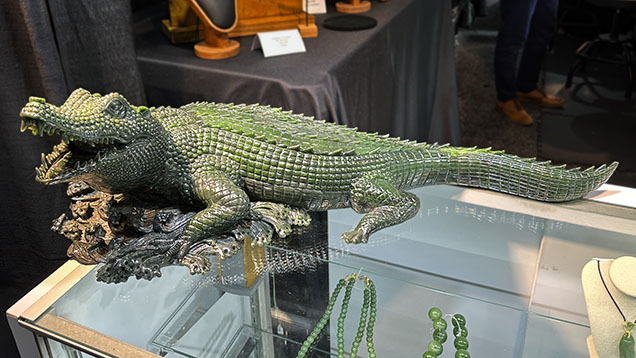
At the AGTA GemFair in Tucson, Arizona (February 2–6), many vendors had very strong sales on opening day, with several reporting challenges to satisfy the demand with on-hand staff. Some AGTA exhibitors expressed concern that the fewer number of show days this year could affect sales, as customers who would normally visit on the weekend might have been deterred by the show ending on Friday. Many Gem & Jewelry Exchange (GJX) vendors indicated that Monday was slow, but attendance picked up on Tuesday after higher-end buyers finished shopping at the AGTA show. High-end and unusual items sold quickly, including a finely carved nephrite Polar Jade alligator from the Polar mine in British Columbia (figure 1). Numerous AGTA and GJX sellers voiced relief that their sales were high enough to not only break even, but resulted in a strong if not near-record year. The foot traffic appeared somewhat lower at other venues, including the Pueblo Gem & Mineral Show, the 22nd Street Mineral, Fossil, Gem & Jewelry Show, and the JOGS Gem & Jewelry Show, but vendors with premium goods at attractive price points reported brisk sales.
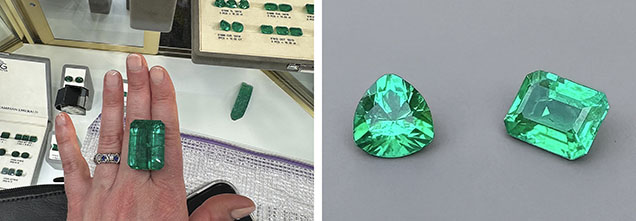
Due to increased challenges for foreign vendors bringing goods into the U.S., some long-time participants did not attend this year. As predicted, empty booths were observed at some of the shows, but an unexpected result was the presence of some new faces at both AGTA and GJX, as vendors who relinquished their booths opened up opportunities for those waitlisted. For example, RG Crystals exhibited at GJX for the first time, selling extraordinary laboratory-grown gems, including synthetic hydrothermal emeralds mimicking both the color and overall appearance of Colombian emerald (figure 2). As with last year, many buyers relied on video calls to coordinate with colleagues, contributing to lower attendance as companies limited the number of staff attending the shows. Buyers and sellers expressed concern over pricing pressures driven by tariffs, reduced global gem availability, and elevated gold and silver prices. The price instability of precious metals also caused some trepidation. In fact, as the shows were starting, the price of silver precipitously dropped more than 30% from $114.43 an ounce on January 29 to $78.53 the very next day, whereas gold dropped about 13% from $5,354.80 an ounce on January 29 to $4,652.60 on February 2. In some venues, this resulted in daily price changes for goods. With diminished international trade activity, many vendors focused on clearing older inventory.
As with last year, GIA’s Show Service Laboratory had an all-time record year. Lab personnel reported that the majority of show submissions were traditional colored stones: ruby, sapphire, emerald, and Paraíba tourmaline.
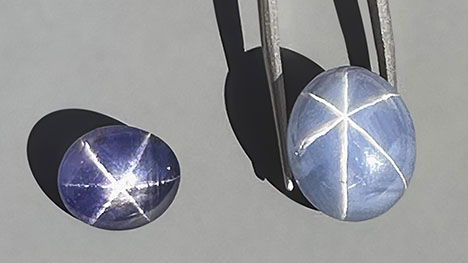
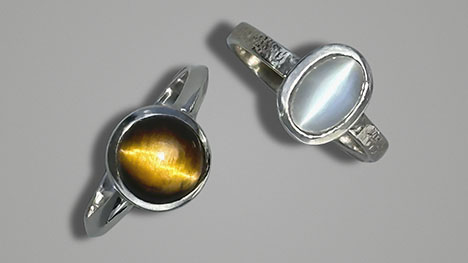
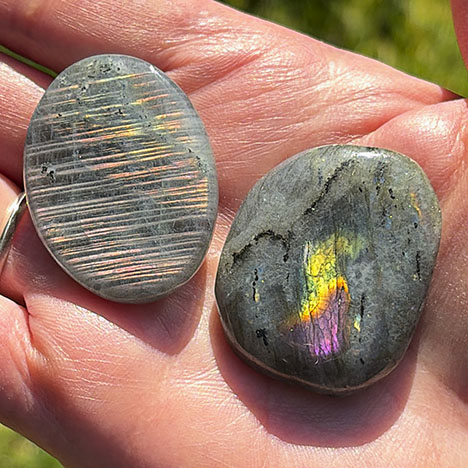
According to exhibitors carrying a wide variety of gem materials, fancy-color sapphires were the most popular stones, particularly pinks and purples, as well as teals and greens. Strong U.S. and international demand for Montana sapphire has driven prices for stones over 1 ct to exceptional levels, reportedly due to increased global awareness and an unpredictable supply of rough. Garnets sold very well this year, and sales of unheated “opalescent” or “sleepy” stones continued to be strong. Star ruby and sapphire (figure 3) were some of the hottest items, followed by cat’s-eye stones (figure 4), including cat’s-eye moonstone, offered at several of the shows at very attractive prices. “Rainbow moonstone” from Madagascar (Spring 2024 GNI, p. 102) continued to sell quickly among buyers. Ethiopian opal was abundant at shows around town, with a particularly strong presence of rough and loose stones at the 22nd Street show. Prices varied widely, offering some highly affordable options; however, prices may start to rise as supply becomes increasingly limited due to the depletion of easily accessible material in the Wollo region. Labradorite was popular at several shows, including a Madagascar variety with a gray matrix and pink flash available at venues such as the Pueblo and 22nd Street shows (figure 5).
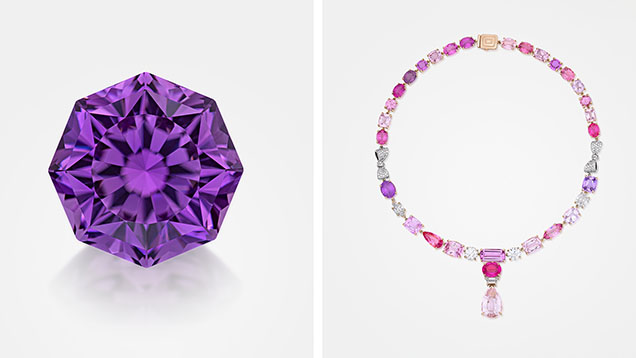
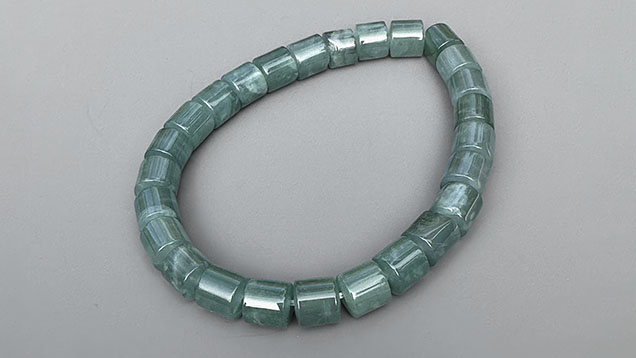
This year’s trending colors included hot pinks and purples, as illustrated by both the AGTA Spectrum and Cutting Edge Buyer’s Choice Awards (figure 6), along with neon blue-green, light green, teal, greenish blue, and lilac. A newer popular material, Guatemalan blue jadeite jade (figure 7), displayed a teal color similar to that of some of the most in-demand unheated Montana sapphire.
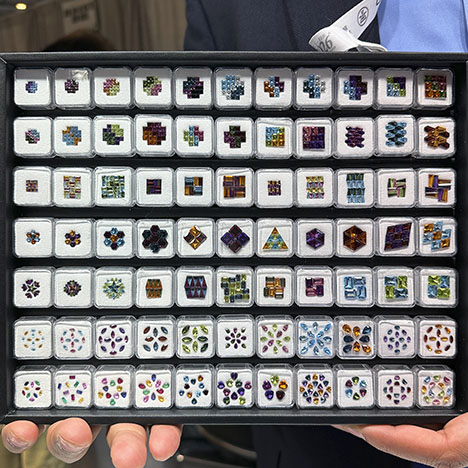
Several cutting trends stood out, driven by demand for well-cut stones maximizing light return and color over carat weight, whether through precision cutting or more unconventional styles. While the term precision cutting was used variably, buyers consistently valued sharp meet points at facet junctions, optimal cutting angles for light return, and mirror-finish flat facets. Precision cutting was illustrated in in a wide variety of small gemstones (figure 8), as well as larger stones. Star shapes were popular at AGTA, appearing in pieces such as the moissanite “Snowflake” and faceted star-cut gems (figure 9) in materials including Montana sapphire, neon beryl, red Idaho garnet, and various quartz. Other unconventional cutting styles, including cubes (figure 10, top) and cones, also attracted considerable attention for their bold architectural approach. Polished gem slabs in rectangles, triangles, and other simple shapes were in demand among several designers. Attractive sapphire slabs with distinct inclusions (figure 10, bottom) and long baguette-cut gems (figure 11) were particularly popular.
In summary, buyers and sellers arrived in Tucson with concerns about availability and pricing, but many found relief as the shows progressed. Although no major new trends or viral products emerged, vendors offered a broad selection of attractively colored gems with an emphasis on cut quality and provenance documentation tracing a stone from the mine to its finished form. Lower foot traffic may be the signal of a lasting shift, as smartphones enable companies to send fewer in-person buyers. Exhibitors also explored creative strategies to navigate tariffs, including arranging U.S.-based storage to reduce repeated border crossings. For some, reduced participation created opportunities, allowing new businesses to secure highly desirable booth spaces across the major shows.
Jennifer Stone-Sundberg is senior technical editor, and Tao Hsu is technical editor, for Gems & Gemology at GIA in Carlsbad, California. Lisa Kennedy is technical advisor at GIA in New York.
At the AGTA GemFair in Tucson, Arizona (February 2–6), many vendors had very strong sales on opening day, with several reporting challenges to satisfy the demand with on-hand staff. Some AGTA exhibitors expressed concern that the fewer number of show days this year could affect sales, as customers who would normally visit on the weekend might have been deterred by the show ending on Friday. Many Gem & Jewelry Exchange (GJX) vendors indicated that Monday was slow, but attendance picked up on Tuesday after higher-end buyers finished shopping at the AGTA show. High-end and unusual items sold quickly, including a finely carved nephrite Polar Jade alligator from the Polar mine in British Columbia (figure 1). Numerous AGTA and GJX sellers voiced relief that their sales were high enough to not only break even, but resulted in a strong if not near-record year. The foot traffic appeared somewhat lower at other venues, including the Pueblo Gem & Mineral Show, the 22nd Street Mineral, Fossil, Gem & Jewelry Show, and the JOGS Gem & Jewelry Show, but vendors with premium goods at attractive price points reported brisk sales.
Due to increased challenges for foreign vendors bringing goods into the U.S., some long-time participants did not attend this year. As predicted, empty booths were observed at some of the shows, but an unexpected result was the presence of some new faces at both AGTA and GJX, as vendors who relinquished their booths opened up opportunities for those waitlisted. For example, RG Crystals exhibited at GJX for the first time, selling extraordinary laboratory-grown gems, including synthetic hydrothermal emeralds mimicking both the color and overall appearance of Colombian emerald (figure 2). As with last year, many buyers relied on video calls to coordinate with colleagues, contributing to lower attendance as companies limited the number of staff attending the shows. Buyers and sellers expressed concern over pricing pressures driven by tariffs, reduced global gem availability, and elevated gold and silver prices. The price instability of precious metals also caused some trepidation. In fact, as the shows were starting, the price of silver precipitously dropped more than 30% from $114.43 an ounce on January 29 to $78.53 the very next day, whereas gold dropped about 13% from $5,354.80 an ounce on January 29 to $4,652.60 on February 2. In some venues, this resulted in daily price changes for goods. With diminished international trade activity, many vendors focused on clearing older inventory.
As with last year, GIA’s Show Service Laboratory had an all-time record year. Lab personnel reported that the majority of show submissions were traditional colored stones: ruby, sapphire, emerald, and Paraíba tourmaline.
According to exhibitors carrying a wide variety of gem materials, fancy-color sapphires were the most popular stones, particularly pinks and purples, as well as teals and greens. Strong U.S. and international demand for Montana sapphire has driven prices for stones over 1 ct to exceptional levels, reportedly due to increased global awareness and an unpredictable supply of rough. Garnets sold very well this year, and sales of unheated “opalescent” or “sleepy” stones continued to be strong. Star ruby and sapphire (figure 3) were some of the hottest items, followed by cat’s-eye stones (figure 4), including cat’s-eye moonstone, offered at several of the shows at very attractive prices. “Rainbow moonstone” from Madagascar (Spring 2024 GNI, p. 102) continued to sell quickly among buyers. Ethiopian opal was abundant at shows around town, with a particularly strong presence of rough and loose stones at the 22nd Street show. Prices varied widely, offering some highly affordable options; however, prices may start to rise as supply becomes increasingly limited due to the depletion of easily accessible material in the Wollo region. Labradorite was popular at several shows, including a Madagascar variety with a gray matrix and pink flash available at venues such as the Pueblo and 22nd Street shows (figure 5).
This year’s trending colors included hot pinks and purples, as illustrated by both the AGTA Spectrum and Cutting Edge Buyer’s Choice Awards (figure 6), along with neon blue-green, light green, teal, greenish blue, and lilac. A newer popular material, Guatemalan blue jadeite jade (figure 7), displayed a teal color similar to that of some of the most in-demand unheated Montana sapphire.
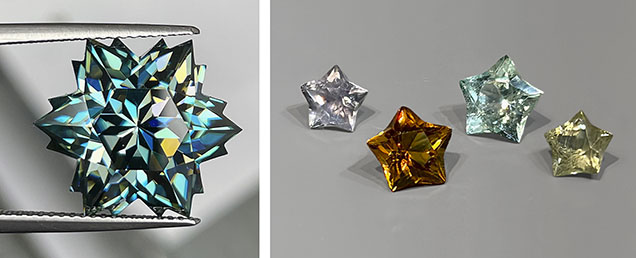
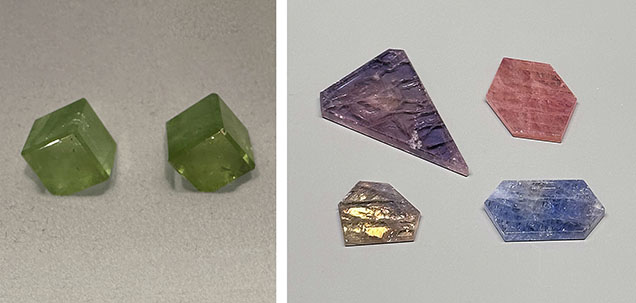
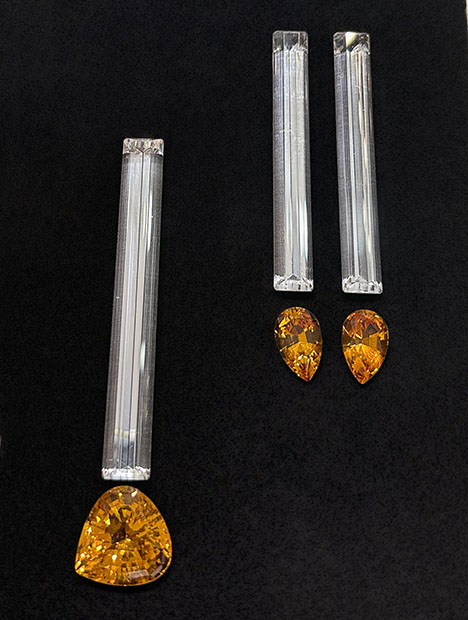
Several cutting trends stood out, driven by demand for well-cut stones maximizing light return and color over carat weight, whether through precision cutting or more unconventional styles. While the term precision cutting was used variably, buyers consistently valued sharp meet points at facet junctions, optimal cutting angles for light return, and mirror-finish flat facets. Precision cutting was illustrated in in a wide variety of small gemstones (figure 8), as well as larger stones. Star shapes were popular at AGTA, appearing in pieces such as the moissanite “Snowflake” and faceted star-cut gems (figure 9) in materials including Montana sapphire, neon beryl, red Idaho garnet, and various quartz. Other unconventional cutting styles, including cubes (figure 10, top) and cones, also attracted considerable attention for their bold architectural approach. Polished gem slabs in rectangles, triangles, and other simple shapes were in demand among several designers. Attractive sapphire slabs with distinct inclusions (figure 10, bottom) and long baguette-cut gems (figure 11) were particularly popular.
In summary, buyers and sellers arrived in Tucson with concerns about availability and pricing, but many found relief as the shows progressed. Although no major new trends or viral products emerged, vendors offered a broad selection of attractively colored gems with an emphasis on cut quality and provenance documentation tracing a stone from the mine to its finished form. Lower foot traffic may be the signal of a lasting shift, as smartphones enable companies to send fewer in-person buyers. Exhibitors also explored creative strategies to navigate tariffs, including arranging U.S.-based storage to reduce repeated border crossings. For some, reduced participation created opportunities, allowing new businesses to secure highly desirable booth spaces across the major shows.
Jennifer Stone-Sundberg is senior technical editor, and Tao Hsu is technical editor, for Gems & Gemology at GIA in Carlsbad, California. Lisa Kennedy is technical advisor at GIA in New York.


