

Since mid-2024, new chrysoprase from Western Australia has been available at gem markets in Bangkok. Discovered by small-scale gold miners, the material is reportedly mined in an area with no previously identified gem mineralizations. However, this discovery lies in a region in which many nickel mineralizations have occurred, and the well-known Yerilla chrysoprase deposit is only a few kilometers from the newly discovered claim.
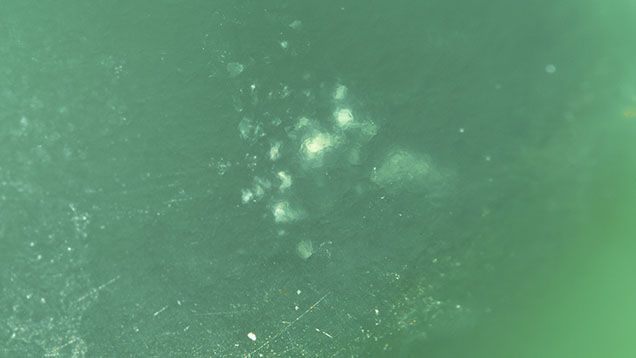
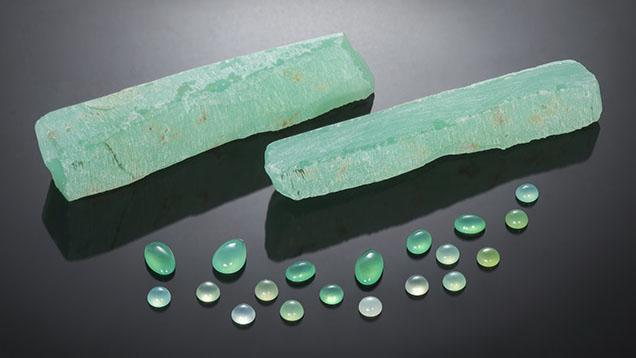
GIA’s Bangkok laboratory recently received a suite of rough and cut stones from John Wibberley, who mined the material (figure 1). The cut samples selected for study were variously shaped cabochons weighing 0.77 to 2.15 ct, in colors ranging from yellow-green to blue-green. Standard gemological properties were consistent with chalcedony. The refractive index was 1.53–1.54 (spot reading), and the hydrostatic specific gravity ranged from 2.59 to 2.65. Fluorescence was generally inert. Observation with a polariscope revealed an aggregate (AGG) reaction; the stone remained light through 360° under crossed filters, indicating an aggregate structure consistent with its cryptocrystalline nature. No reaction was observed when the stones were viewed through a Chelsea filter. Microscopic examination revealed a cryptocrystalline structure with whitish inclusions exhibiting a cottony texture (figure 2), as well as tiny orangy brown/black and fluid inclusions.
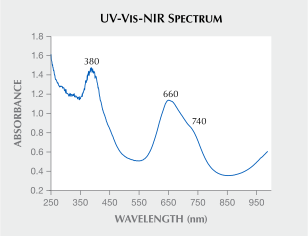
Analysis using both a handheld spectroscope and ultraviolet/visible/near-infrared (UV-Vis-NIR) spectroscopy revealed two main broad absorption bands in the violet (~380 nm) and red (~660 nm) regions, along with an additional feature at approximately 740 nm attributed to Ni2+. These absorptions left a transmission window in the green-blue region, producing the characteristic hue of chrysoprase, caused by Ni2+ (figure 3; Y. Jiang and Y. Guo, “Genesis and influencing factors of the colour of chrysoprase,” Scientific Reports, Vol. 11, 2021, article no. 9939).
Energy-dispersive X-ray fluorescence confirmed the presence of nickel, the chromophore defining this green variety of chalcedony. Silicon was also detected, consistent with chalcedony’s composition. Chromium, iron, and copper, which can also contribute color in other chalcedony varieties, were not detected. Fourier-transform infrared spectra displayed patterns typical of chalcedony.
Despite limited volume, this new discovery has gained some attention from connoisseurs, especially in markets with an appetite for fine green translucent gemstones.
Aprisara Semapongpan is a staff gemologist at GIA in Bangkok.
Since mid-2024, new chrysoprase from Western Australia has been available at gem markets in Bangkok. Discovered by small-scale gold miners, the material is reportedly mined in an area with no previously identified gem mineralizations. However, this discovery lies in a region in which many nickel mineralizations have occurred, and the well-known Yerilla chrysoprase deposit is only a few kilometers from the newly discovered claim.
GIA’s Bangkok laboratory recently received a suite of rough and cut stones from John Wibberley, who mined the material (figure 1). The cut samples selected for study were variously shaped cabochons weighing 0.77 to 2.15 ct, in colors ranging from yellow-green to blue-green. Standard gemological properties were consistent with chalcedony. The refractive index was 1.53–1.54 (spot reading), and the hydrostatic specific gravity ranged from 2.59 to 2.65. Fluorescence was generally inert. Observation with a polariscope revealed an aggregate (AGG) reaction; the stone remained light through 360° under crossed filters, indicating an aggregate structure consistent with its cryptocrystalline nature. No reaction was observed when the stones were viewed through a Chelsea filter. Microscopic examination revealed a cryptocrystalline structure with whitish inclusions exhibiting a cottony texture (figure 2), as well as tiny orangy brown/black and fluid inclusions.
Analysis using both a handheld spectroscope and ultraviolet/visible/near-infrared (UV-Vis-NIR) spectroscopy revealed two main broad absorption bands in the violet (~380 nm) and red (~660 nm) regions, along with an additional feature at approximately 740 nm attributed to Ni2+. These absorptions left a transmission window in the green-blue region, producing the characteristic hue of chrysoprase, caused by Ni2+ (figure 3; Y. Jiang and Y. Guo, “Genesis and influencing factors of the colour of chrysoprase,” Scientific Reports, Vol. 11, 2021, article no. 9939).
Energy-dispersive X-ray fluorescence confirmed the presence of nickel, the chromophore defining this green variety of chalcedony. Silicon was also detected, consistent with chalcedony’s composition. Chromium, iron, and copper, which can also contribute color in other chalcedony varieties, were not detected. Fourier-transform infrared spectra displayed patterns typical of chalcedony.
Despite limited volume, this new discovery has gained some attention from connoisseurs, especially in markets with an appetite for fine green translucent gemstones.
Aprisara Semapongpan is a staff gemologist at GIA in Bangkok.


