

At the Pueblo Gem & Mineral Show, a visit with self-described “crystal machinist” Todd Wacks (Tucson Todd’s Gems, Arizona) did not disappoint. Wacks, who apprenticed with master faceter Meg Berry, has been cutting gems professionally for more than a decade. His approach to gem cutting prioritizes beauty and results in distinctive cuts and patterns tailored to each gemstone. Wacks believes that cuts should be shaped to the natural form of the rough rather than forced into a preset, potentially wasteful pattern. Every stone he cuts is unique and optimized for the piece of rough, with a strict adherence to appropriate pavilion and crown angles coupled with extremely flat facets and a mirror polish. Wacks has a special passion for garnets (e.g., E. Hogarth, “Beyond Beauty: A Garnet Necklace Decoded,” Spring 2024 G&G, pp. 140–143), with extensive experience cutting thousands of them.
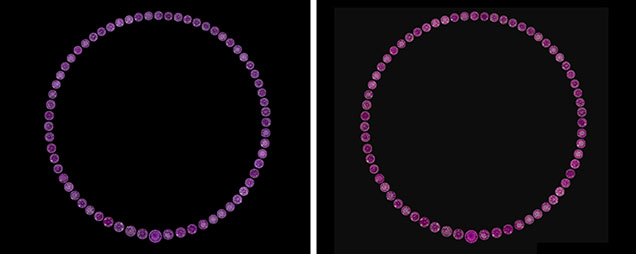
An exceptional graduated suite of 65 matched color-change pyrope garnets from Morogoro, Tanzania, weighing 106.35 carats total, drew significant attention at his booth. These garnets, ranging from 6.5 to 9.5 mm in diameter, change from a bright pinkish purple in daylight to a hot pink in incandescent lighting (see above). What distinguished this one-of-a-kind set was the extraordinary clarity achieved for each stone. Wacks noted that producing the perfectly matched suite required nearly 6 kilograms of rough, hundreds of production hours, and the cutting of more than 100 stones. His primary challenge was addressing the clarity issues characteristic of this garnet, which required consistently removing hazier stones rich with rutile needles.
The material, a garnet ranging in color from bright pink to purple, was reportedly discovered in 1987 (C.M. Stockton, “Pastel pyropes,” Summer 1988 G&G, pp. 104–106), but initially drew little interest as it was included, mistaken for rhodolite garnet, and its color-change property had not yet been recognized. For Wacks, the story began in 2014, when three dealers approached him with a new “pink” garnet rough that had been stored in a safe for nearly 30 years. After cutting a sample, he was excited by the color and decided to set it into a ring. Wacks noticed a color change from purple to hot pink as he moved the ring from his microscope’s fluorescent lighting to his polishing station’s incandescent lighting. At this point, he was sure he had something worth investigating further. After gathering some standard gemological data including refractive index (1.729) and specific gravity (3.61), along with an unfamiliar spectrum from a spectroscope, Wacks realized that he could not definitively match the garnet to any varieties he knew. This prompted him and several colleagues to submit material to GIA’s laboratory, which confirmed it as a distinct variety: a vanadium- and chromium-bearing pyrope garnet exhibiting color shifts or changes between illumination sources (Spring 2015 GNI, pp. 88–89; Z. Sun et al., “Vanadium- and chromium-bearing pink pyrope garnet: Characterization and quantitative colorimetric analysis,” Winter 2015 G&G, pp. 348–369).
After acquiring a substantial portion of the available rough in 2014, Wacks has since faceted many of these distinctive garnets, producing stones as large as 35 ct. With the source now exhausted and only limited material remaining, this high-quality suite of unique pyrope garnets was noteworthy to see. We look forward to seeing what Wacks produces next, as he has recently been expanding his skill set by training as a gem carver in Idar-Oberstein.
Jennifer Stone-Sundberg is senior technical editor for Gems & Gemology at GIA in Carlsbad, California.
At the Pueblo Gem & Mineral Show, a visit with self-described “crystal machinist” Todd Wacks (Tucson Todd’s Gems, Arizona) did not disappoint. Wacks, who apprenticed with master faceter Meg Berry, has been cutting gems professionally for more than a decade. His approach to gem cutting prioritizes beauty and results in distinctive cuts and patterns tailored to each gemstone. Wacks believes that cuts should be shaped to the natural form of the rough rather than forced into a preset, potentially wasteful pattern. Every stone he cuts is unique and optimized for the piece of rough, with a strict adherence to appropriate pavilion and crown angles coupled with extremely flat facets and a mirror polish. Wacks has a special passion for garnets (e.g., E. Hogarth, “Beyond Beauty: A Garnet Necklace Decoded,” Spring 2024 G&G, pp. 140–143), with extensive experience cutting thousands of them.
An exceptional graduated suite of 65 matched color-change pyrope garnets from Morogoro, Tanzania, weighing 106.35 carats total, drew significant attention at his booth. These garnets, ranging from 6.5 to 9.5 mm in diameter, change from a bright pinkish purple in daylight to a hot pink in incandescent lighting (see above). What distinguished this one-of-a-kind set was the extraordinary clarity achieved for each stone. Wacks noted that producing the perfectly matched suite required nearly 6 kilograms of rough, hundreds of production hours, and the cutting of more than 100 stones. His primary challenge was addressing the clarity issues characteristic of this garnet, which required consistently removing hazier stones rich with rutile needles.
The material, a garnet ranging in color from bright pink to purple, was reportedly discovered in 1987 (C.M. Stockton, “Pastel pyropes,” Summer 1988 G&G, pp. 104–106), but initially drew little interest as it was included, mistaken for rhodolite garnet, and its color-change property had not yet been recognized. For Wacks, the story began in 2014, when three dealers approached him with a new “pink” garnet rough that had been stored in a safe for nearly 30 years. After cutting a sample, he was excited by the color and decided to set it into a ring. Wacks noticed a color change from purple to hot pink as he moved the ring from his microscope’s fluorescent lighting to his polishing station’s incandescent lighting. At this point, he was sure he had something worth investigating further. After gathering some standard gemological data including refractive index (1.729) and specific gravity (3.61), along with an unfamiliar spectrum from a spectroscope, Wacks realized that he could not definitively match the garnet to any varieties he knew. This prompted him and several colleagues to submit material to GIA’s laboratory, which confirmed it as a distinct variety: a vanadium- and chromium-bearing pyrope garnet exhibiting color shifts or changes between illumination sources (Spring 2015 GNI, pp. 88–89; Z. Sun et al., “Vanadium- and chromium-bearing pink pyrope garnet: Characterization and quantitative colorimetric analysis,” Winter 2015 G&G, pp. 348–369).
After acquiring a substantial portion of the available rough in 2014, Wacks has since faceted many of these distinctive garnets, producing stones as large as 35 ct. With the source now exhausted and only limited material remaining, this high-quality suite of unique pyrope garnets was noteworthy to see. We look forward to seeing what Wacks produces next, as he has recently been expanding his skill set by training as a gem carver in Idar-Oberstein.
Jennifer Stone-Sundberg is senior technical editor for Gems & Gemology at GIA in Carlsbad, California.


