

Opals are widely known for their play-of-color phenomenon, and although precious opals can also fluoresce, none are as vividly colored as the siliceous sinters that originate from Hokkaido, Japan (Fall 2026 Lab Notes, pp. 296–298). After volcanic activity 10,000 to 60,000 years ago dammed the Shikaribetsu River, andesitic volcanic ejecta deposited along the western banks of Lake Shikaribetsu formed these fluorescent sinters through the incorporation of organic material (S. Ogihara, “Characteristics of fluorescent organic matter entrapped in silica sinter from the western shore of Lake Shikaribetsu, Hokkaido, Japan,” Open Journal of Geology, Vol. 15, No. 7, 2025, pp. 377–389).
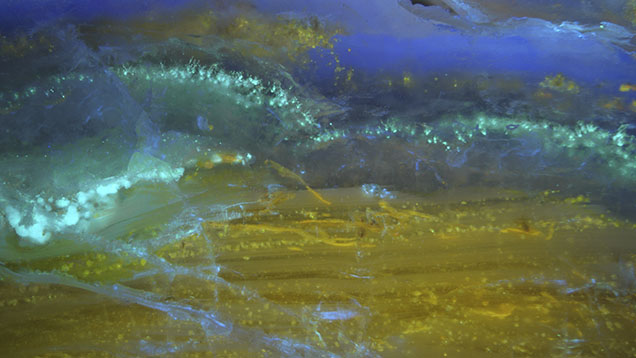
The author recently examined an opal slab, weighing 159.59 ct and measuring 71.87 × 47.05 × 7.66 mm, from this location in Japan. The colors depicted in the figure above are attributed to rare hydrocarbon crystal inclusions, including carpathite and the recently discovered hokkaidoite (F. Bosi et al., “IMA commission on new minerals, nomenclature and classification (CNMNC): Newsletter 71,” Mineralogical Magazine, Vol. 87, No. 2, 2023, pp. 332–335). Microscopic examination revealed dendritic structures along the thin cyan bands, not visible under normal lighting conditions. Under daylight-equivalent lighting, translucent yellow to orange bands were associated with bright yellow fluorescence. The semitransparent, near-colorless side of the slab exhibited a resinous luster and pastel blue to purple fluorescence under long-wave (365 nm) UV light, appearing blue in the photomicrograph. Together, the fluorescent colors and banded structures evoke a vivid natural landscape, resembling powerful ocean waves breaking along an eroding shoreline.
Jeffrey Hernandez is an advanced staff gemologist at GIA in Carlsbad, California.


