

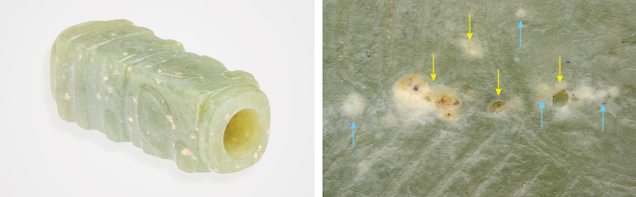
A square columnar carving with a cylindrical bore, measuring 15 × 15 × 39 mm (figure 1, left), was recently submitted to the National Center of Quality Inspection and Testing on Gold-Silver Products (NGGC) for identification. Carvings of this form, known as yu cong in Chinese, were produced mainly during the late Neolithic and early Bronze Ages for ritual purposes. The specimen’s pale grayish green bodycolor, along with a mottled appearance caused by a whitish patina layer and white corrosion spots on the surface, created an initial impression of an ancient nephrite jade artifact.
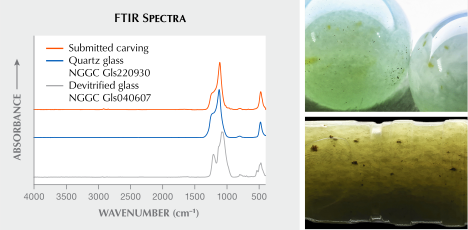
Infrared reflectance spectroscopy, however, revealed the fingerprint absorption pattern of amorphous silica, indicating the material was either quartz glass or opal (figure 2, left). The measured refractive index of 1.45 supported this interpretation. Due to the carving’s hollow interior, hydrostatic specific gravity testing was not applicable.
Microscopic examination showed the white corrosion spots were irregular or round micro pits filled with white waxy substances likely introduced during or after polishing. Some round white inclusions were observed just beneath the surface (figure 1, right). Their resemblance to the pits suggested that the pits were white inclusions exposed on the surface during the carving process. The round shape of pits and inclusions is typically associated with bubbles in glass.
Up to this point, all evidence pointed to a glass carving, with two exceptions. First, artificial devitrified glass can mimic the porridge-like texture of natural nephrite jade, but its texture is isotropic—unlike this carving’s slightly oriented porridge-like texture (figure 2, right), which usually indicates nephrite from Xinjiang, China. Furthermore, the infrared fingerprint spectrum of artificial devitrified glass significantly differs from that of quartz glass (again, see figure 2, left).
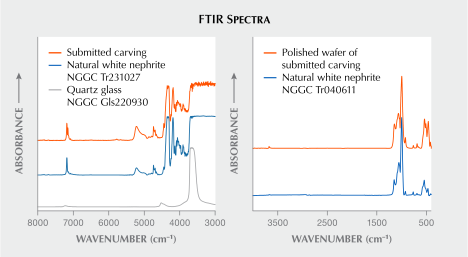
Additional examinations were conducted to gather more evidence. On the carving’s surface, the whitish patina layer showed weak whitish fluorescence under 370 nm ultraviolet light, while the grayish green matrix material remained inert. Raman spectra collected from multiple fluorescence-inert areas corresponding to the matrix consistently matched the pattern for tremolite. Meanwhile, the infrared transmittance spectrum in the 3000–8000 cm–1 range exhibited the characteristic hydroxyl absorptions of nephrite jade (figure 3). These findings confirmed the presence of a nephrite component in the carving yet appeared to contradict the earlier results, creating a paradox. One possible explanation, considering persistent rumors that some jade simulants are made by mixing jade powder with a cementing agent, was that the carving was made of glass mixed with a minor amount of nephrite powder. This hypothesis seemed to explain the results thus far, but it was insufficient to support a confident conclusion.
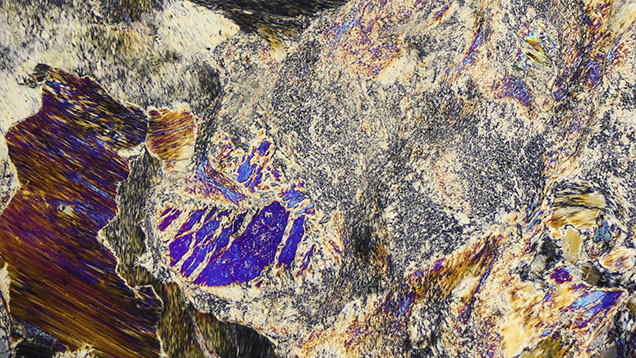
With the owner’s permission, two polished wafers and two thin sections were sliced from the carving. The infrared reflectance spectrum of one of the polished wafers showed a nephrite pattern exclusively (figure 3), and magnification of the thin sections using cross-polarized light revealed a texture of fine fibrous tremolite interspersed with tremolite phenocrysts, while no optically isotropic substance such as glass was observed (figure 4). The carving was finally confirmed to be solid natural nephrite, leaving only the question of what caused the abnormal surface features.
It is well known that antique-style jade objects are sometimes artificially aged using calcination or chemical corrosion. Because tremolite decomposes into calcium-magnesium pyroxenes (typically diopside and enstatite) when heated above 900°C, this nephrite carving was more likely treated by chemical corrosion. An acidic solution can extract calcium and magnesium from the surface of nephrite, leaving a silica-rich layer that appears chalky and matte and exhibits whitish fluorescence. In all previous cases at NGGC, the surface of an aged nephrite object—whether naturally or artificially aged—had never been so thoroughly corroded and transformed into silica, and thus their infrared reflectance spectra had always retained a nephrite pattern (with slight spectral distortion due to surface structure degradation often observed).
The present case raises a clear warning that aging treatments for nephrite jade objects can completely alter the mineral composition at and near the surface, resulting in a series of gemological and spectral features that could mislead even experienced gemologists relying on nondestructive testing methods.
Bowen Zhao, Dingying Chen, and Weiji Qian are affiliated with the National Center of Quality Inspection and Testing on Gold-Silver Products (NGGC) in Shanghai. Yuchen Zhang is affiliated with the Zhong Bao Center of Gem and Jade Identification in Shanghai.
A square columnar carving with a cylindrical bore, measuring 15 × 15 × 39 mm (figure 1, left), was recently submitted to the National Center of Quality Inspection and Testing on Gold-Silver Products (NGGC) for identification. Carvings of this form, known as yu cong in Chinese, were produced mainly during the late Neolithic and early Bronze Ages for ritual purposes. The specimen’s pale grayish green bodycolor, along with a mottled appearance caused by a whitish patina layer and white corrosion spots on the surface, created an initial impression of an ancient nephrite jade artifact.
Infrared reflectance spectroscopy, however, revealed the fingerprint absorption pattern of amorphous silica, indicating the material was either quartz glass or opal (figure 2, left). The measured refractive index of 1.45 supported this interpretation. Due to the carving’s hollow interior, hydrostatic specific gravity testing was not applicable.
Microscopic examination showed the white corrosion spots were irregular or round micro pits filled with white waxy substances likely introduced during or after polishing. Some round white inclusions were observed just beneath the surface (figure 1, right). Their resemblance to the pits suggested that the pits were white inclusions exposed on the surface during the carving process. The round shape of pits and inclusions is typically associated with bubbles in glass.
Up to this point, all evidence pointed to a glass carving, with two exceptions. First, artificial devitrified glass can mimic the porridge-like texture of natural nephrite jade, but its texture is isotropic—unlike this carving’s slightly oriented porridge-like texture (figure 2, right), which usually indicates nephrite from Xinjiang, China. Furthermore, the infrared fingerprint spectrum of artificial devitrified glass significantly differs from that of quartz glass (again, see figure 2, left).
Additional examinations were conducted to gather more evidence. On the carving’s surface, the whitish patina layer showed weak whitish fluorescence under 370 nm ultraviolet light, while the grayish green matrix material remained inert. Raman spectra collected from multiple fluorescence-inert areas corresponding to the matrix consistently matched the pattern for tremolite. Meanwhile, the infrared transmittance spectrum in the 3000–8000 cm–1 range exhibited the characteristic hydroxyl absorptions of nephrite jade (figure 3). These findings confirmed the presence of a nephrite component in the carving yet appeared to contradict the earlier results, creating a paradox. One possible explanation, considering persistent rumors that some jade simulants are made by mixing jade powder with a cementing agent, was that the carving was made of glass mixed with a minor amount of nephrite powder. This hypothesis seemed to explain the results thus far, but it was insufficient to support a confident conclusion.
With the owner’s permission, two polished wafers and two thin sections were sliced from the carving. The infrared reflectance spectrum of one of the polished wafers showed a nephrite pattern exclusively (figure 3), and magnification of the thin sections using cross-polarized light revealed a texture of fine fibrous tremolite interspersed with tremolite phenocrysts, while no optically isotropic substance such as glass was observed (figure 4). The carving was finally confirmed to be solid natural nephrite, leaving only the question of what caused the abnormal surface features.
It is well known that antique-style jade objects are sometimes artificially aged using calcination or chemical corrosion. Because tremolite decomposes into calcium-magnesium pyroxenes (typically diopside and enstatite) when heated above 900°C, this nephrite carving was more likely treated by chemical corrosion. An acidic solution can extract calcium and magnesium from the surface of nephrite, leaving a silica-rich layer that appears chalky and matte and exhibits whitish fluorescence. In all previous cases at NGGC, the surface of an aged nephrite object—whether naturally or artificially aged—had never been so thoroughly corroded and transformed into silica, and thus their infrared reflectance spectra had always retained a nephrite pattern (with slight spectral distortion due to surface structure degradation often observed).
The present case raises a clear warning that aging treatments for nephrite jade objects can completely alter the mineral composition at and near the surface, resulting in a series of gemological and spectral features that could mislead even experienced gemologists relying on nondestructive testing methods.
Bowen Zhao, Dingying Chen, and Weiji Qian are affiliated with the National Center of Quality Inspection and Testing on Gold-Silver Products (NGGC) in Shanghai. Yuchen Zhang is affiliated with the Zhong Bao Center of Gem and Jade Identification in Shanghai.


