

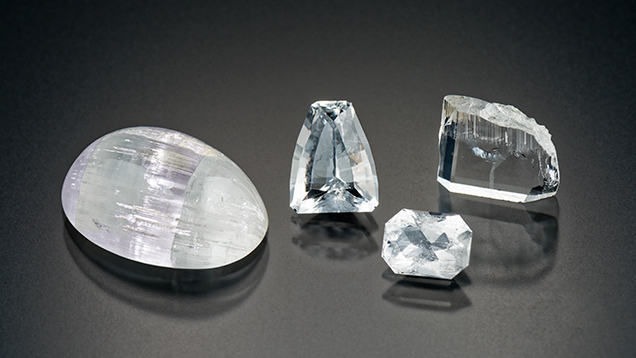
The sodium beryllium phosphate mineral beryllonite (NaBePO4) is a rare gem coveted by collectors. The material is typically fashioned as a transparent colorless faceted stone but occasionally as a cat’s-eye cabochon (figure 1). Recently, an interesting colorless rough specimen studied at GIA’s Carlsbad laboratory exhibited an unusually sharp, obvious separation between two regions. One area contained a high density of hollow tubes, while the other was clean and transparent.
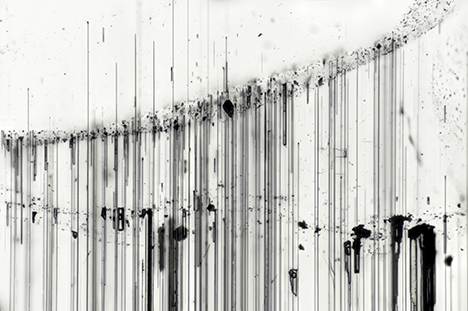
Chatoyant beryllonite gems have been reported previously (Spring 1991 GNI, pp. 47–48), but this peculiar specimen offers a clue to the mechanism that gives rise to the chatoyant phenomenon. The answer lies in the separation between the two regions, which is where minute inclusions (figure 2) were deposited during growth of the crystal. This created a localized blockage of necessary nutrients, preventing growth of the host mineral and leaving behind the parallel tubes (Summer 2010 Lab Notes, pp. 55–56). This collector’s cat’s-eye beryllonite, with its beautiful contrasting black-and-white inclusion scene, furthers our understanding of chatoyancy in this mineral.
The sodium beryllium phosphate mineral beryllonite (NaBePO4) is a rare gem coveted by collectors. The material is typically fashioned as a transparent colorless faceted stone but occasionally as a cat’s-eye cabochon (figure 1). Recently, an interesting colorless rough specimen studied at GIA’s Carlsbad laboratory exhibited an unusually sharp, obvious separation between two regions. One area contained a high density of hollow tubes, while the other was clean and transparent.
Chatoyant beryllonite gems have been reported previously (Spring 1991 GNI, pp. 47–48), but this peculiar specimen offers a clue to the mechanism that gives rise to the chatoyant phenomenon. The answer lies in the separation between the two regions, which is where minute inclusions (figure 2) were deposited during growth of the crystal. This created a localized blockage of necessary nutrients, preventing growth of the host mineral and leaving behind the parallel tubes (Summer 2010 Lab Notes, pp. 55–56). This collector’s cat’s-eye beryllonite, with its beautiful contrasting black-and-white inclusion scene, furthers our understanding of chatoyancy in this mineral.


